With consistent testing and maintenance, you protect your pool from cloudiness by keeping chemistry balanced (pH 7.2-7.6, alkalinity 80-120 ppm, free chlorine 1-3 ppm), running the filter daily 8-12 hours, cleaning skimmers and backwashing routinely, brushing walls and vacuuming debris, shocking after heavy use or storms, and using clarifiers or phosphate removers when needed; test frequently and address issues promptly to maintain clear, safe water.
Over time, your pool can become cloudy from imbalanced chemicals, poor filtration, debris and algae; you can prevent this by testing and adjusting pH and chlorine regularly, running and maintaining your filter, brushing and skimming weekly, shocking after heavy use or storms, and using clarifiers or enzymatic treatments as needed-consistent maintenance and prompt correction of issues keeps your water clear and safe.
Key Takeaways:
- Maintain sanitizer levels: keep free chlorine around 1-3 ppm (higher in hot weather) and shock after heavy use or storms.
- Balance water chemistry: pH 7.2-7.6, total alkalinity 80-120 ppm, calcium hardness 200-400 ppm; test regularly.
- Optimize filtration and circulation: run the pump for a full turnover daily (typically 8-12 hours), clean skimmer baskets, and backwash or clean filters as needed.
- Minimize contaminants: skim debris, use a pool cover, and encourage swimmers to shower to reduce oils, lotions, and organics.
- Use treatments when needed: apply clarifiers or flocculants to clear fine particles and use algaecide or shock treatments to prevent and eliminate algae.
Key Takeaways:
- Run and maintain filtration: operate the pump daily (8-12+ hours in hot weather), clean skimmer baskets, backwash or replace filters as needed.
- Keep sanitizer and oxidizer levels steady: maintain free chlorine at 1-3 ppm (or appropriate for your sanitizer) and shock after heavy use or storms to remove combined contaminants.
- Balance water chemistry: maintain pH 7.2-7.6, total alkalinity 80-120 ppm, calcium hardness 200-400 ppm, and stabilizer (CYA) 30-50 ppm.
- Control organics and algae: skim, brush, and vacuum regularly; use clarifier or flocculant for fine particles and algaecide or phosphate remover when needed.
- Test frequently and act fast: test water at least twice weekly in peak season, troubleshoot cloudy causes (filter, chemistry, organics) and correct them promptly.
Understanding Cloudy Water
Causes of Cloudy Water in Pools
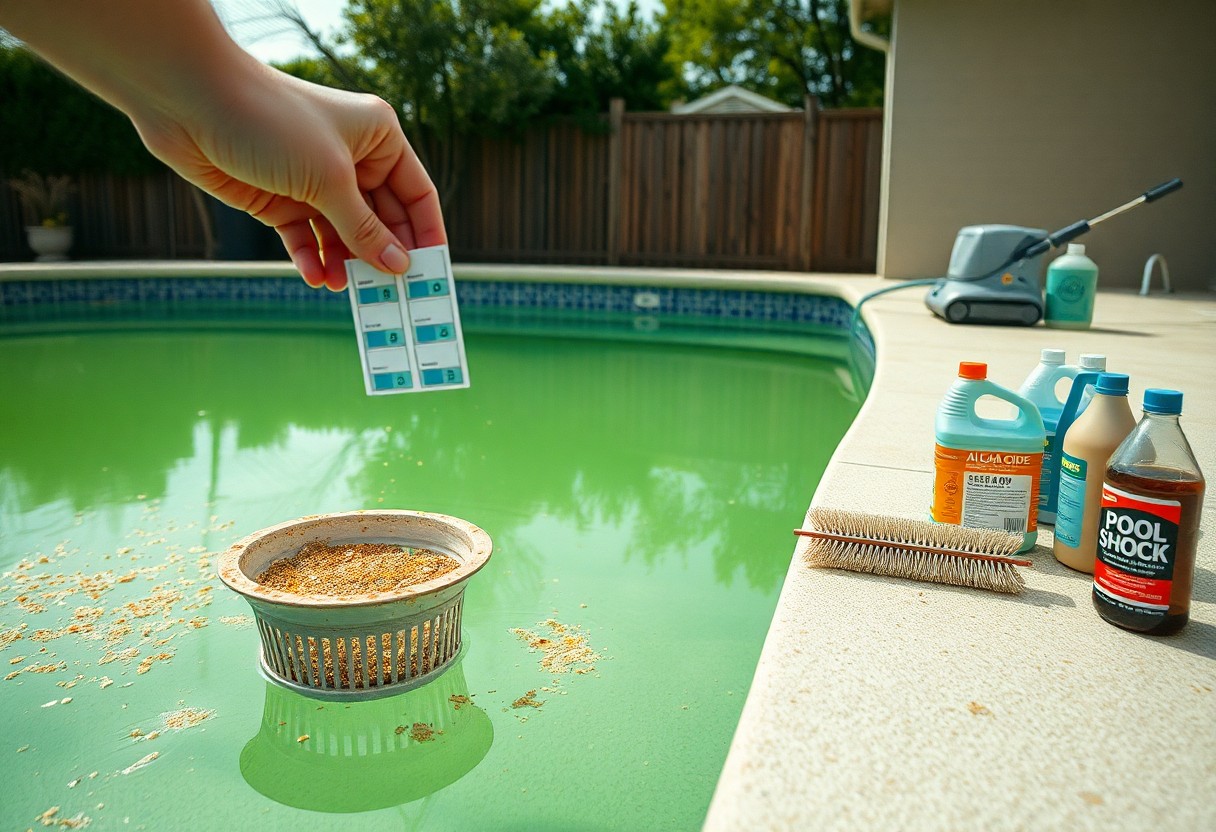
When free chlorine falls below the recommended 1-3 ppm or pH rises above 7.8, particles and algae can clump and cloud your water; high cyanuric acid (>70 ppm) lowers sanitizer effectiveness. Heavy bather load, storm runoff, and calcium hardness over ~400 ppm introduce organics and minerals that overwhelm filtration. If you run the pump fewer than 8-12 hours daily or rely on a sand filter (20-40 micron) instead of DE (2-5 micron) or a fine cartridge (10-15 micron), suspended debris will persist.
Effects of Cloudy Water
If visibility drops below one meter due to suspended particles, you increase drowning risk and reduce safe swimmer supervision; cloudy water also shelters bacteria and protozoa from disinfectants, raising illness potential. Equipment impact follows quickly: clogged filters raise system pressure, lower flow, force pumps to work harder, and calcium-rich cloudiness can form scale on heaters, pumps, and plaster, shortening component life.
You’ll often see combined chlorine (chloramines) climb above the desirable <0.2 ppm in cloudy pools, causing eye and respiratory irritation and signaling high organic load. In that situation you may need breakpoint chlorination-typically about 10 times the combined chlorine-to oxidize contaminants; commercial pools with persistent turbidity face closures until turbidity and free chlorine meet health standards, which also protects you from liability and outbreaks.
Understanding Cloudy Water
What Causes Cloudy Water?
Cloudiness comes from suspended particulates like pollen, sunscreen, body oils, and fine dust, plus biological growth such as algae; chemical imbalance-low free chlorine, high combined chlorine (chloramines), or incorrect pH-lets those particles persist. Mechanical issues also matter: sand filters typically trap 20-40 microns, cartridge filters 10-15 microns, and DE filters 2-5 microns, so a clogged or undersized filter or running it less than 8-12 hours daily often leaves microscopic debris suspended and the pool hazy.
Common Pool Chemicals and Their Roles
You rely on a few key chemicals: free chlorine (target 1-3 ppm) for sanitation, cyanuric acid/stabilizer (30-50 ppm) to protect chlorine from UV, pH control (ideal 7.2-7.6) to maximize sanitizer effectiveness, total alkalinity (80-120 ppm) to buffer pH, and calcium hardness (200-400 ppm) to prevent scale or etching. Additionally, clarifiers and flocculants bind fine particles for easier removal, while algaecides prevent blooms between shocks.
Chlorine oxidizes organics and destroys pathogens, but when combined chlorine rises above 0.2-0.5 ppm you get chloramines, which cause odor and cloudiness; breakpoint chlorination-raising free chlorine, often toward ~10 ppm temporarily-breaks those bonds. pH shifts even 0.2 units reduce chlorine activity noticeably, so you adjust with muriatic acid or sodium bicarbonate to keep chemistry within those ranges and let your sanitizer work efficiently.
Importance of Water Clarity
You need clear water for safety, maintenance efficiency, and swimmer confidence: visibility to the pool floor lets you spot hazards and algae early, reduces the load on your filter system, and keeps chemical dosing consistent. Public and private pools that maintain clarity also lower operational costs because effective disinfection uses less chemical and avoids frequent backwashing or deep cleaning cycles.
In practice, clear water lets you detect color shifts-green for algae, brown for metals-before stains form, and keeps filtration cycles stable so you backwash based on pressure rise (commonly 8-10 psi above baseline) rather than frequent guesswork. Many operators monitor turbidity and aim for very low readings (well under 1 NTU) to ensure both safety and cost-effective upkeep.
Routine Maintenance
Regular Skimming and Vacuuming
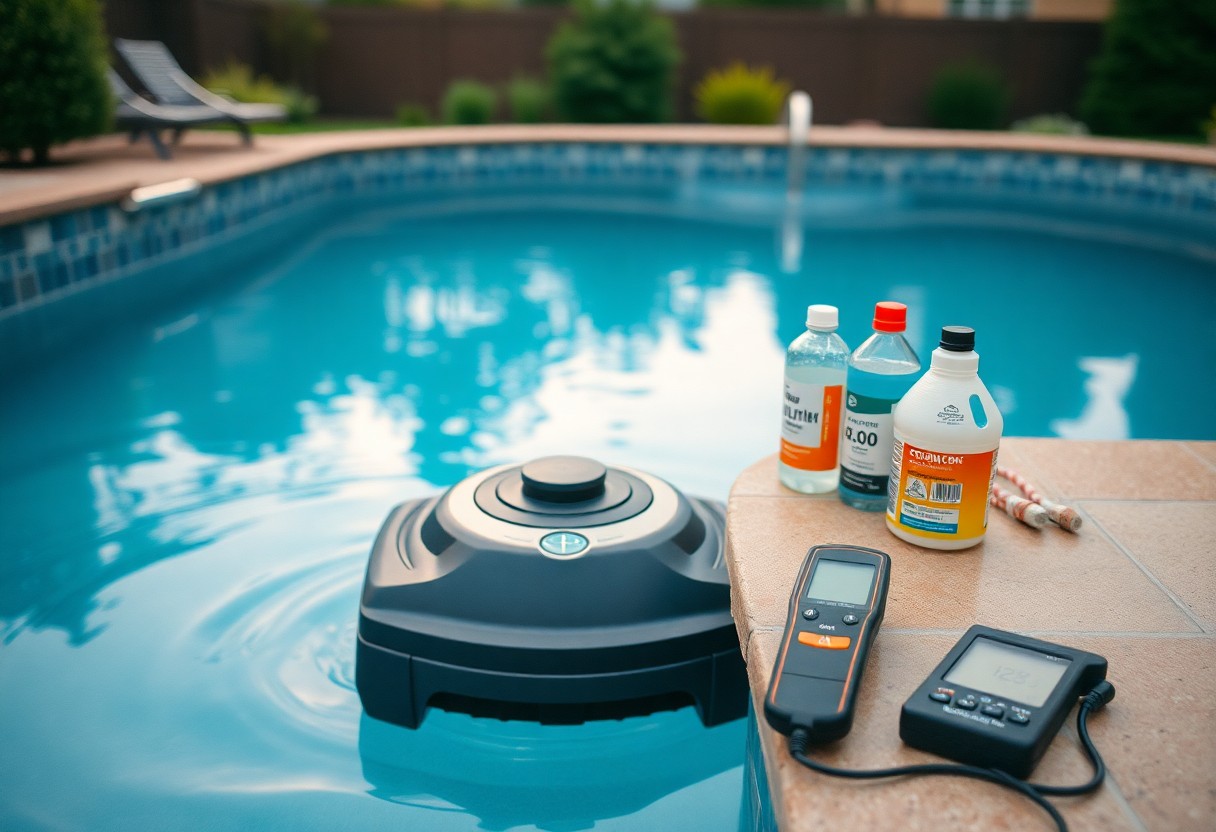
Your pool clears faster when you skim daily and vacuum weekly; aim for 10-15 minutes of skimming each day and a 30-45 minute vacuum session once a week. Skim surface debris like leaves and pollen before it sinks, and run a manual vacuum or automatic cleaner along walls and the floor to prevent organic buildup that feeds algae and clouds water. Empty skimmer baskets after heavy use and use a leaf net during peak foliage seasons.
Cleaning the Pool Filter
You should backwash sand and DE filters when pressure rises 8-10 psi above the clean baseline, and clean cartridge filters every 3-6 months or sooner if flow drops. Always turn off the pump before servicing, inspect O-rings and seals while the unit is open, and note the baseline pressure after cleaning so you can detect future clogging early.
For deeper cleaning, remove cartridges or DE grids and soak them 12-24 hours in a commercial filter cleaner following label directions, then rinse with a high-pressure hose until water runs clear. After backwashing DE filters, add fresh DE powder per your filter’s specification (many systems use about 1 lb per 10 sq ft of grid area), and plan professional sand replacement every 5-7 years for sand filters to maintain capture efficiency.
Balancing Pool Chemicals
You should test water 2-3 times weekly with a reliable kit and target pH 7.4-7.6, free chlorine 1-3 ppm, total alkalinity 80-120 ppm, and calcium hardness 200-400 ppm to keep water clear. Adjust pH in small doses with muriatic acid or sodium bisulfate, and perform a shock treatment after heavy use or storms to break down combined chlorine and organics.
Keep cyanuric acid (stabilizer) between 30-50 ppm to protect chlorine from UV loss, and shock weekly as a proactive measure-many pool owners use about 1 lb of granular shock per 10,000 gallons as a common guideline. Always calculate pool volume (length × width × average depth × 7.5 = gallons for rectangular pools), follow product labels for dosing, and retest 24 hours after shocking to confirm free chlorine has returned to the 1-3 ppm range.
Water Testing
Importance of Regular Testing
Test your pool water 2-3 times per week as a baseline and daily after heavy rain, a party, or high bather load. Aim for free chlorine 1-3 ppm, pH 7.2-7.6, total alkalinity 80-120 ppm, calcium hardness 200-400 ppm, and cyanuric acid 30-50 ppm; deviations outside these ranges often lead directly to cloudiness or scale formation.
How to Test Pool Water
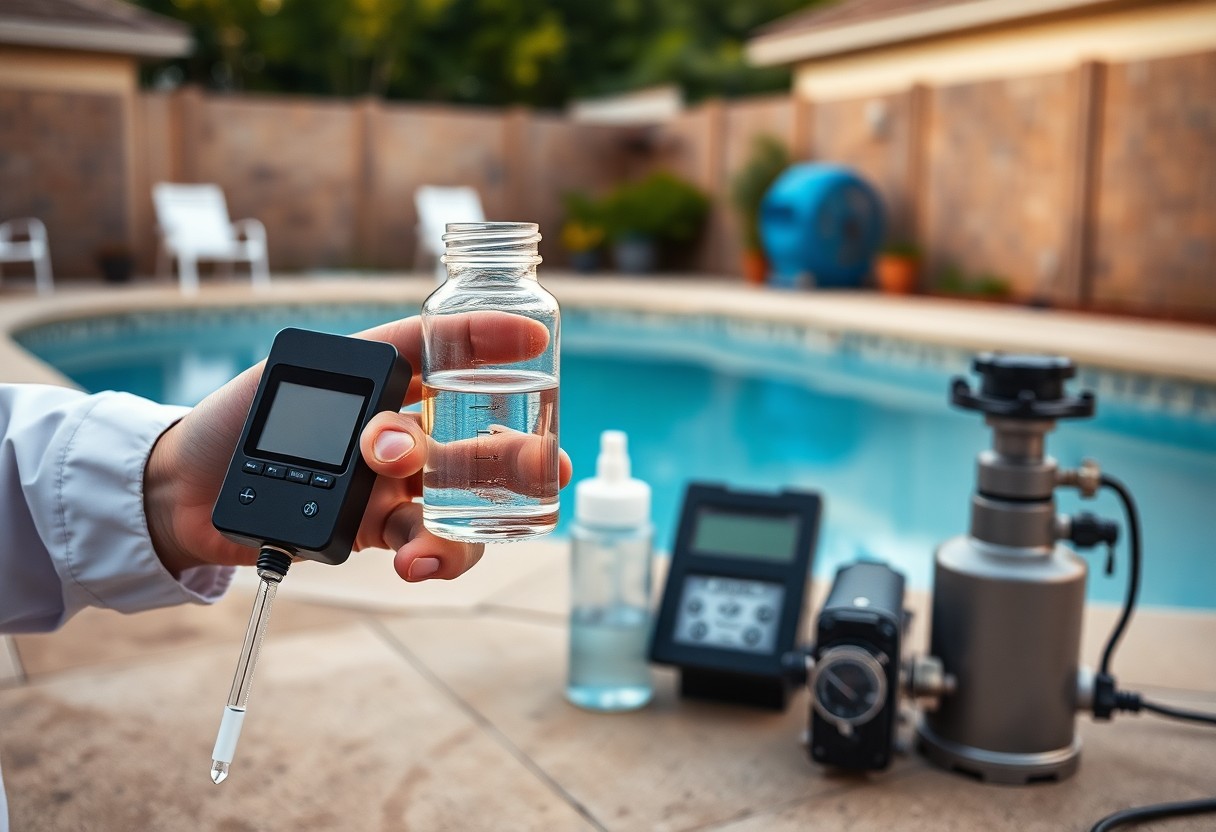
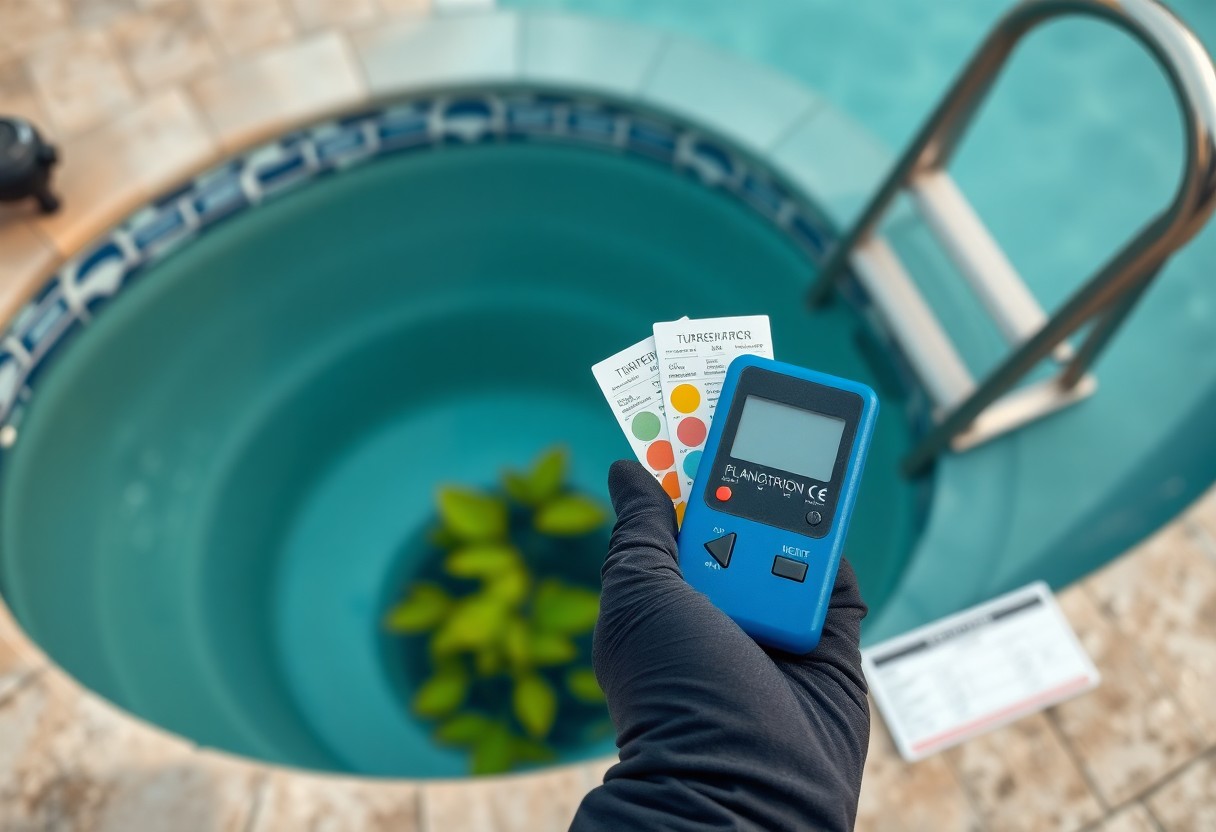
Collect a sample from elbow-deep away from returns and skimmers, then use test strips, a liquid titration kit, or a digital photometer to measure free chlorine, pH, alkalinity, calcium hardness, and CYA. Test strips give quick pass/fail guidance, while titration kits and photometers provide the accuracy you need for corrective dosing.
For best accuracy, perform a titration for free and combined chlorine-drop-count kits measure to 0.1 ppm increments-while a photometer removes subjectivity for pH and CYA. If you see combined chlorine above 0.5 ppm, record that value and calculate breakpoint: you’ll need to raise free chlorine to roughly 10× the combined chlorine level. Bring a fresh sample to your local pool store when results are inconsistent or when CYA looks unusually high.
Interpreting Test Results
Translate numbers into actions: low free chlorine (<1 ppm) requires immediate chlorine increase, high pH (>7.8) reduces sanitizing power and calls for pH down, and alkalinity outside 80-120 ppm will cause pH swings that lead to cloudiness. Treat combined chlorine over 0.5 ppm as a sign of chloramines-shock the pool and retest frequently until combined chlorine drops.
Apply specific fixes based on volume: for shocking, raise free chlorine to 5-10 ppm for routine shock or to breakpoint (about 10× combined chlorine) for chloramine problems; if CYA exceeds 100 ppm, dilute with fresh water because chlorine will be less effective. To raise total alkalinity, add sodium bicarbonate per product dosing (typical rule: ~1.5 lb per 10,000 gallons raises TA ~10 ppm); lower pH with muriatic acid or sodium bisulfate following label instructions and retest after full circulation.
Monitoring Water Quality
Importance of Regular Testing
Test your water at least once a week and after heavy rain, pool parties, or visible cloudiness; pH should sit near 7.4-7.6, free chlorine 1-3 ppm, total alkalinity 80-120 ppm, and calcium hardness 200-400 ppm. Rapid testing lets you correct imbalances before algae or scale form, and if combined chlorine rises above 0.2 ppm you should shock the pool to restore clarity and comfort.
Recommended Testing Tools
Use a mix of methods: test strips for quick checks, a liquid titration kit (e.g., Taylor K-2006) for accurate alkalinity and chlorine, and a digital photometer or ColorQ for precise ppm readings; consider an ORP meter if you use non-chlorine sanitizers. Test routine: strip daily or before use, full kit weekly, photometer monthly or after treatment changes.
Test strips cost about $10-$20 per pack of 50 and give rapid pass/fail guidance, while liquid kits cost $20-$60 and reduce color-matching errors for alkalinity and cyanuric acid. Photometers run $200-$600 but deliver numeric precision for chlorine, bromine and pH; ORP probes need calibration and replacement every 1-2 years. If your Plano pool sees heavy bather load or frequent storms, invest in a photometer or schedule monthly professional testing to avoid recurring cloudiness.
Chemical Treatments
Shock Treatments
When you need to clear cloudy water fast, perform a shock: raise free chlorine to breakpoint levels – typically about 10 times the combined chlorine or a target around 10 ppm for common issues – and maintain it for 8-24 hours. Use granular calcium hypochlorite or lithium hypochlorite; roughly 1 lb of 65-73% calcium hypochlorite per 10,000 gallons raises FC by ~7-10 ppm. Run the filter continuously and test every few hours until clarity returns.
Flocculants and Clarifiers
Polymeric clarifiers and flocculants work differently: clarifiers (often polymeric) dose at ~1-4 oz per 10,000 gallons to coagulate submicron particles so your filter can catch them, while flocculants (alum or metal-based) form larger flakes that settle for vacuuming to waste. Use clarifiers for cartridge/DE filters and flocculants with a waste line or sand filters; keep pH near 7.2-7.6 for best performance.
For best results, lower pH to about 7.2 before treating, add the product in the evening, and run the pump 2-4 hours to distribute. Then stop the pump and allow 6-12 hours for floc to settle; vacuum to waste or backwash the filter. Avoid overusing flocculants on cartridge filters – they can cake and require deep cleaning – and always follow label dosing for your pool volume (e.g., 10,000-30,000 gallons).
Algaecides
Use algaecides as a follow-up or prevention: copper-based products are effective at 0.2-0.5 ppm but can stain if used improperly; quaternary ammonium (polyquat) products are stain-free and typically dosed at 1-4 ppm for maintenance. Apply after shocking and brushing, then run filtration; for heavy blooms use the “shock” or double dose per the label and continue brushing until algae clears.
When treating persistent algae, rotate between copper and polyquat chemistries to avoid resistance, and add a sequestrant if you use copper in a plaster or light-colored pool to reduce staining risk. Check compatibility: don’t add certain algaecides immediately before or after metal sequestrants or enzymes unless the label permits, and always confirm residual chlorine is within safe ranges before returning swimmers.
Maintaining Chemical Balance
pH Levels
Keep pH between 7.2 and 7.6 to prevent cloudiness and protect surfaces; pH below 7.2 depletes chlorine and can etch plaster, while above 7.6 reduces sanitizer effectiveness and promotes scale. Test at least twice weekly during swim season and after storms. Use sodium carbonate to raise pH or sodium bisulfate/muriatic acid to lower it, adding chemicals in small doses and retesting after several hours of circulation.
Alkalinity and Calcium Hardness
Maintain total alkalinity at 80-120 ppm to stabilize pH swings; low TA causes rapid pH bounce and high TA leads to pH lock and cloudy water. Target calcium hardness around 200-400 ppm for gunite/plaster pools and roughly 150-250 ppm for vinyl/liner pools. You can raise TA with baking soda and lower it with diluted muriatic acid added near returns, then circulate and retest after 4-6 hours.
Test TA and hardness weekly and act on results: for a 20,000-gallon pool, about 1.5 lb of baking soda per 10,000 gallons raises TA by ~10 ppm (so ~3 lb raises ~20 ppm). When calcium hardness is low, add calcium chloride per product instructions to prevent surface etching; if hardness climbs above ~600 ppm, plan a partial drain/refill or use sequestering agents for sensitive liners to reduce scaling and cloudiness.
Chlorine Levels
Aim for free chlorine of 1.0-3.0 ppm for routine sanitation; free chlorine under 1 ppm allows algae and cloudy water, while sustained levels above 5 ppm irritate skin and eyes. Monitor combined chlorine (chloramines) and keep it under 0.5 ppm. Test daily during hot months or heavy use, and maintain cyanuric acid (stabilizer) around 30-50 ppm for outdoor pools so sunlight doesn’t rapidly degrade chlorine.
If combined chlorine rises above 0.5 ppm perform breakpoint chlorination: raise free chlorine to roughly 10 times the combined chlorine level and maintain that elevated FC for several hours while running filtration. For example, with 1 ppm combined chlorine target about 10 ppm free chlorine, use non-stabilized liquid chlorine or calcium hypochlorite for shock, then retest and continue normal maintenance once combined chlorine falls below ~0.2 ppm.
Pool Environment Management
Proper Pool Cover Use
You should use the right cover type for season and goals: a solid winter cover blocks 95% of evaporation and most debris, a solar cover can raise water temperature by up to 6-10°F and cut heating costs, and a mesh cover handles heavy leaf loads while draining rain. Fit the cover snugly, remove large debris before uncovering, and run circulation 4-6 hours daily even when covered to prevent stagnation and maintain chemical balance.
Managing Debris and Leaves
Skim your pool 5-10 minutes daily during leaf season and empty skimmer baskets at least every 2-3 days; use a leaf rake for big clumps and a suction-side leaf canister or robotic cleaner for continuous pickup. Deploy a large leaf net over the surface if trees shed heavily in November-February, and check the pump strainer before you run the filter to avoid clogs.
Match debris strategy to your filter: backwash sand and DE systems when pressure rises 8-10 psi above the clean baseline, and clean cartridge filters every 4-6 weeks or when flow drops noticeably. Install skimmer socks to trap fine matter, brush walls weekly to prevent organic staining, and blow leaves off the deck so they don’t blow back in-combining daily skimming with scheduled filter maintenance prevents clouds from organics and silt.
Monitoring Weather Impacts
After storms test water within 24 hours-heavy rain dilutes chlorine and shifts pH-keep free chlorine normally at 1-3 ppm and raise to 5 ppm for a short shock if you see cloudiness or combined chlorine spikes. Wind increases debris load and heat spikes raise chlorine demand, so plan to run the pump 4-8 extra hours post-storm and adjust chemicals to pH 7.2-7.6 for optimal sanitizer effectiveness.
In Plano, fast-moving summer storms or seasonal pollen can drop free chlorine from 3 ppm to below 1 ppm within hours; in such cases a common remedy is 1 lb of calcium hypochlorite shock per ~10,000 gallons (follow product directions) and continuous filtration for 24 hours. Also watch for acid rain after storms-test total alkalinity and pH and correct alkalinity to 80-120 ppm to stabilize pH, reducing the chance of recurring cloudiness.
Preventative Measures
Educating Pool Users
You should require a 30-60 second rinse before entry, ask swimmers to remove makeup and heavy lotions, and insist that children under 3 wear properly fitting swim diapers changed every 60 minutes; advise applying sunscreen 10-20 minutes before swimming to reduce oily residues. These habits cut organic load that feeds algae and cloudiness, and make chemical control much easier during busy weekends or pool parties.
Setting Rules for Poolside Behavior
You must post and enforce clear rules: no food or glass on deck, no pets, no swim with ordinary diapers, and limit occupancy to one person per 15 sq ft of water surface; schedule a 10-15 minute water break every 60-90 minutes during heavy use to skim debris and test chemistry. Clear rules reduce contaminants and make filtration and disinfection predictable.
Place laminated rule signs at entry points and on the deck, include rules on membership/registration forms, and require a brief orientation for new users. Train staff or assign a responsible family member to count bathers and log counts; test free chlorine and pH every hour during peak use and record results. Consistent enforcement-warnings followed by temporary suspension-cuts repeat violations and measurably lowers organic load over a season.
Installing a Good Filtration System
You should choose the right filter type and size: DE filters trap particles down to about 1-3 microns, cartridges ~10-15 microns, and sand ~20-40 microns; aim for a full turnover every 6-8 hours and run the pump 8-12 hours daily to meet that target. Backwash sand/DE systems or clean cartridges when filter pressure rises 8-10 psi above baseline to prevent bypass of fine particulates.
Size equipment to your pool volume and desired turnover: turnover hours = pool gallons ÷ pump gpm ÷ 60 (example: a 20,000‑gal pool at 50 gpm = ~6.7 hours). Prefer a variable‑speed pump to match flow to filter capacity and save energy (typically 50-70% less than single‑speed). Clean cartridges monthly, backwash as needed, and plan to replace DE grids or cartridge elements every 3-5 years; consult a certified pool technician to confirm piping, pump curve, and filter area for reliable clarity.
Enhancing Filtration Systems
Types of Pool Filters
Sand, cartridge, and diatomaceous earth (DE) filters each address cloudiness differently; sand is low-maintenance but filters to ~20-40 microns, cartridges trap ~10-20 microns, and DE captures down to ~2-5 microns for the best clarity. Knowing which fits your pool size, bather load, and local pollen/algae pressures will determine routine and upgrade needs.
- Sand: backwashable, low cost, replace sand every ~5 years.
- Cartridge: no backwash, clean every 3-6 months, replace every 3-5 years.
- DE: finest filtration, backwash + add DE powder, grids serviced annually.
| Filter Type | Key Detail |
|---|---|
| Sand | Filters ~20-40 μm; backwash when pressure ↑8-10 psi; sand change ≈5 years. |
| Cartridge | Filters ~10-20 μm; rinse 4-6 weeks, deep clean 3-6 months, replace 3-5 years. |
| DE | Filters ~2-5 μm; backwash + add DE; disassemble and hose grids annually. |
| Hybrid/Upgrades | Sand-to- cartridge conversions or added clarifiers can improve micron capture and reduce cloudiness. |
Filter Maintenance
You should monitor the pressure gauge weekly and act when pressure is 8-10 psi above the clean baseline; backwash sand/DE systems until the return runs clear, and rinse cartridges until debris is gone, increasing frequency during high-pollen spring months.
When servicing, follow a sequence: shut pump off, relieve pressure, then backwash or remove cartridges. For cartridges, hose at a 45° angle to avoid damage and soak in manufacturer-recommended cleaner overnight for grease removal; avoid pressure washers. For DE, backwash, then add measured DE powder per label while pump runs, and schedule a grid inspection yearly. Track baseline pressure after a fresh clean so you can spot the 8-10 psi rise that signals cleaning is due.
Conclusion
Following this, you can prevent cloudy water in your Plano pool by keeping filtration running and clean, testing and balancing pH, alkalinity and chlorine regularly, shocking after heavy use or rain, brushing and vacuuming surfaces, cleaning skimmers and filters, controlling phosphates and stabilizer levels, and limiting contaminants from swimmers. Consistent maintenance and prompt corrective actions will keep your water clear and safe.
Algae Prevention and Treatment
Preventative Measures
Keep free chlorine between 1-3 ppm and pH at 7.2-7.6, with cyanuric acid near 30-50 ppm to limit algae growth. Run your pump at least 8-12 hours daily and increase to 12-24 hours during hot months or after storms. Brush walls weekly, vacuum debris, backwash when filter pressure rises 8-10 psi, and apply a monthly maintenance algaecide or shock after heavy bather load or rainfall.
Algae Treatment Options
If you spot algae, raise free chlorine to about 10 ppm for green algae and maintain it until water clears, then add a quaternary or polyquat algaecide to prevent rebound. Test and lower pH before shocking for maximum effectiveness, run your filter 24/7, brush surfaces every 4-6 hours, and vacuum or backwash as algae is captured.
For dosing examples, 1 lb of 65% calcium hypochlorite typically raises chlorine roughly 7 ppm per 10,000 gallons, so a 20,000‑gal pool would need about 2 lbs to reach ~14 ppm for a heavy shock; hold elevated chlorine 24-48 hours. Use copper or specialty algaecides for stubborn black algae plus aggressive brushing; consider phosphate removers to starve recurring blooms. If dead algae cloud the water, clarify with flocculant and vacuum to waste or use a clarifier and extended filtration until clarity returns. For entrenched black or mustard algae, consult a pro for acid wash or DE filter treatment.
Importance of Regular Cleaning
Surface Cleaning and Skimming
You should skim the surface daily for 5-10 minutes with a fine-mesh leaf net to remove leaves, insects, and sunscreen films; empty the skimmer basket weekly and after storms, and run an automatic cleaner or vacuum at least once a week to catch heavier debris-Plano’s spring/fall tree drop often doubles debris load, so increase frequency then.
Wall and Floor Brush Techniques
Brush walls and floors 2-3 times per week for 5-15 minutes, selecting the brush to match your finish-stainless steel for gunite, nylon for plaster and fiberglass, soft-bristle for vinyl-and focus on the waterline and corners so you dislodge algae and biofilm before the filter has to work harder.
Start brushing from the deep end and work toward the shallow end, using vertical strokes on walls and overlapping horizontal strokes on the floor; divide the pool into quadrants and methodically cover each area, paying extra attention behind ladders, steps, and return jets where buildup hides. After brushing, run the circulation pump for at least 6-8 hours and backwash or clean the filter cartridge if pressure rises; during algae outbreaks brush daily for 2-4 days and maintain continuous filtration until clarity returns.
Professional Maintenance Services
When to Hire a Professional
If cloudiness persists beyond 24-48 hours after you’ve shocked, brushed, and run the filter, call a pro. Also hire help after heavy storms, visible algae, or when test strips show free chlorine below 1 ppm, combined chlorine above 0.2 ppm, phosphate levels over 100 ppb, or total dissolved solids nearing 1,500 ppm. Persistent high filter pressure (8-10 psi above baseline) or pump cavitation are signs you need professional diagnostics and repairs.
Benefits of Professional Assistance
Technicians bring calibrated photometers (e.g., Taylor models) and lab-grade reagents to give you accurate readings to 0.1 ppm, eliminating guesswork. They can clear cloudiness in 1-3 visits using targeted treatments-flocculation, phosphate removers, enzyme blends, or D.E. polishes-while optimizing turnover (typically 8-10 hours) and chemical balances so you don’t overuse chlorine or damage plaster and equipment.
For example, a Plano tech cleaned a 25,000‑gallon pool in two visits by reducing phosphates from 350 ppb to under 100 ppb, performing a 24‑hour floc and backwashing when filter pressure rose 10 psi, then restoring free chlorine to 2-4 ppm; that approach saved the owner from premature filter replacement and cut treatment time from weeks to days.
FAQ
Q: What are the most common causes of cloudy water in my Plano pool?
A: Cloudy water usually comes from poor filtration (clogged filter, insufficient run time), imbalanced chemistry (high pH, low free chlorine, improper total alkalinity, incorrect calcium hardness), fine suspended particles (pollen, dust, silt), organic contaminants (body oils, sunscreen, leaves), high phosphates, or early-stage algae. Local conditions in Plano – heavy pollen, summer heat, and thunderstorms – increase organic load and demand on sanitizer and filtration.
Q: What weekly maintenance routine prevents cloudiness?
A: Test and record chemistry 2-3 times per week: free chlorine 1-3 ppm, pH 7.2-7.6, total alkalinity 80-120 ppm, calcium hardness 200-400 ppm, cyanuric acid 30-50 ppm (if using stabilized chlorine). Skim and brush surfaces, vacuum or automatic-cleaner as needed, empty pump and skimmer baskets, and backwash or clean the filter when pressure rises 8-10 psi over baseline. Run the pump long enough for one full turnover daily (typically 8-12 hours; increase to 12-16 hours during hot or high-use periods).
Q: How do I maintain my filter and pump to keep water clear?
A: Inspect pump and filter weekly: clear debris from skimmer/pump baskets, check filter pressure, and backwash sand/DE filters when pressure rises 8-10 psi. For DE filters, add fresh DE after backwash. Clean cartridge filters every 1-3 months or sooner if pressure climbs; soak with cartridge cleaner for organics. Ensure pump strainer lid O-ring seals and valves are functioning. Replace worn laterals, grids, or cartridges to restore proper flow and filtration efficiency.
Q: Which chemical fixes work if my pool is already cloudy?
A: Test first. If chlorine is low, perform a shock treatment per product label to re-establish free chlorine (algae or heavy organics often need a higher free-chlorine demand). Correct pH to 7.2-7.6 and adjust alkalinity to the target range. Use a clarifier to coagulate fine particles so the filter can remove them; use a flocculant only when you can vacuum settled solids to waste. If phosphates are high, use a phosphate remover. Only add chemicals according to label instructions and retest after treatment.
Q: What Plano-specific prevention tips reduce clouding from pollen, storms, and high temperatures?
A: During pollen season run the pump longer and clean skimmer baskets daily, use a fine-filter pre-filter or leaf net during heavy pollen events, and brush surfaces frequently to stop organic buildup. After storms or heavy use, shock the pool and recheck sanitizer levels. Consider upgrading to a higher-efficiency DE or fine-cartridge filter to capture smaller particles common with dust and pollen. Keep consistent chemical maintenance through hot months to prevent loss of sanitizer and algae growth.