Overall, you should choose a cartridge filter for most Plano residential pools because it gives the best balance of fine filtration, lower energy use, and minimal upkeep; cartridges trap smaller particles than sand, avoid frequent backwashing, and fit your equipment pad. If you need the absolute finest clarity and don’t mind extra maintenance, DE is superior; sand is appropriate for large or commercial systems where simplicity and low initial cost matter.
Key Takeaways:
- Cartridge filters offer a strong balance of filtration efficiency, lower energy use, and easier maintenance for most residential Plano pools.
- DE (diatomaceous earth) filters provide the finest water clarity and particle removal but have higher cost and maintenance demands.
- Sand filters are the most affordable and simple to operate, though they capture larger particles and may require more chemical treatment for crystal-clear water.
- Select based on pool size, bather load, budget, and pump compatibility; heavily used or larger pools often benefit from DE or high-capacity cartridge systems.
- Account for turnover rate, micron rating, ease of cleaning, and local water conditions; get a local pool professional to size equipment for Plano’s hot, algae-prone climate.
Understanding Plano Pools
Overview of Plano Pools
In Plano, summer highs often reach 95-100°F, so most pools are outdoor and see heavy sun, pollen and leaf debris. Many homeowners have gunite or fiberglass shells in the 12,000-30,000 gallon range; if your pool is near lawns you’ll get extra grass and fertilizer runoff. You need materials and systems that resist high UV, steady chlorination and frequent skimming to keep water balanced and surfaces protected.
Importance of Proper Filtration
Proper filtration keeps water clear, reduces chemical demand and prevents algae during long warm seasons. Target a turnover of 6-8 hours; for example, a 20,000‑gallon pool requires roughly 2,500 gph (≈42 gpm) for an 8‑hour turnover. You should match pump flow and filter capacity-too much flow through the wrong media lowers capture efficiency and raises costs.
Diving deeper, choose a filter based on particle capture and maintenance: DE filters trap ~2-5 microns, cartridges ~10-15 microns, and sand ~20-40 microns. Monitor filter pressure and backwash or clean when pressure climbs about 8-10 psi above baseline; cartridge elements typically need rinsing every 3-6 months, while DE requires backwash plus adding powder. Pair your filter with a variable‑speed pump and run it longer at lower RPMs-many Plano pools run 8-12 hours daily-to balance turnover, energy use and effective filtration.
Types of Pool Filters
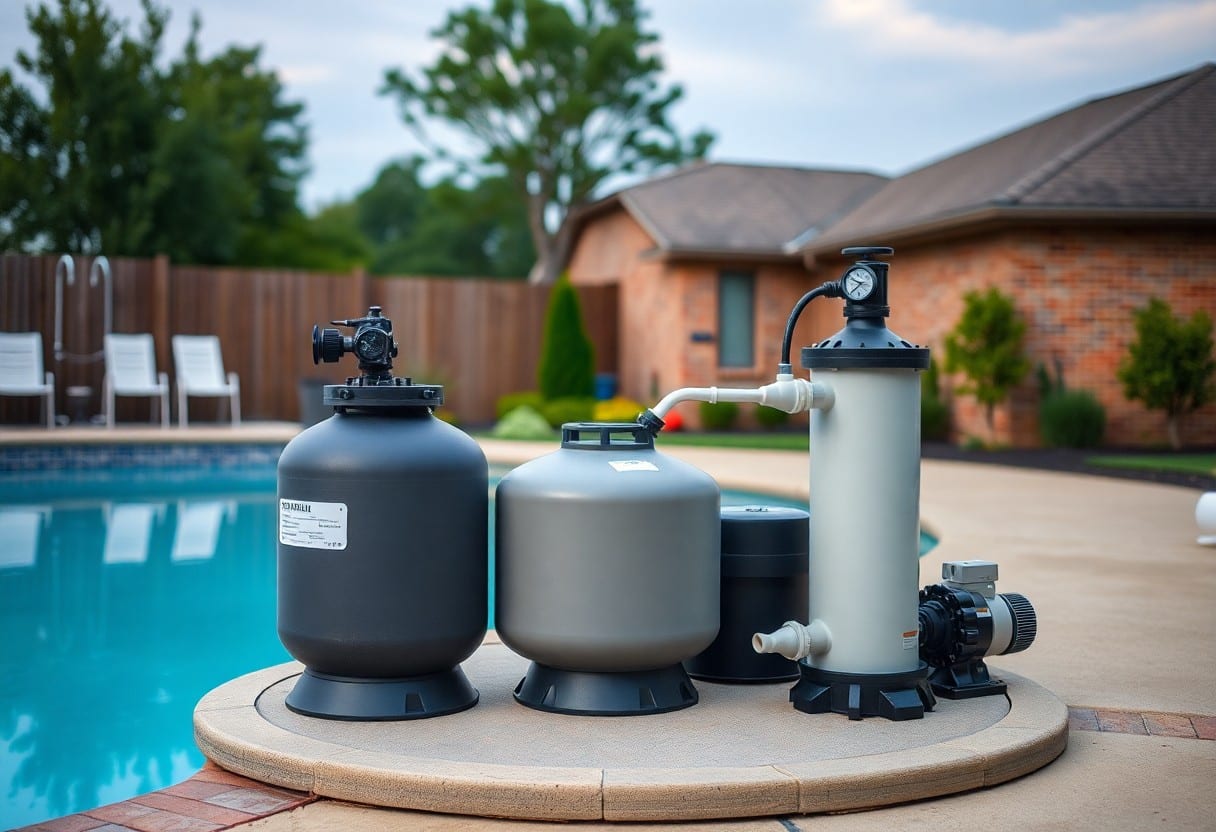
| Sand Filter | Affordable; filters ~20-40 microns; backwash required; sand lasts ~5-7 years |
| Cartridge Filter | Filters ~10-15 microns; large surface area (50-300 sq ft); no backwash; cartridges need periodic cleaning/replacement |
| Diatomaceous Earth (DE) Filter | Finest filtration ~2-5 microns; DE-coated grids; highest clarity; higher maintenance and cost |
| Typical Lifespan & Maintenance | Sand media 5-7 years; cartridges 2-5 years; DE grids 3-5 years; backwash for sand/DE, hose/soak for cartridges |
| Average Cost Range | Sand $300-$800; Cartridge $200-$1,200; DE $600-$1,500 (installation varies) |
Sand Filters
You’ll find sand filters are the most budget-friendly option; they trap particles down to about 20-40 microns using graded silica sand and handle heavy flow rates well. You should backwash every 1-4 weeks depending on pool use, and expect to replace the sand roughly every 5-7 years. They work reliably for larger Plano pools with moderate debris like leaves and pollen.
Cartridge Filters
Cartridge filters capture particles down to 10-15 microns and give you two to five times the surface area of sand, so run times between cleanings are longer. You simply remove and hose off cartridges; replacements vary by quality but commonly last 2-5 years. Cartridges save water because you don’t backwash.
When choosing cartridges, check pleat material and total surface area-common options range 50-300 sq ft; a 150 sq ft cartridge on a 20,000-gallon pool often runs 2-4 weeks between cleanings under normal bather load. You should perform a deep soak with a mild detergent every 6-12 months to remove oils and scale; avoid harsh acids that degrade polyester media. Cartridge systems are especially effective if you prioritize lower water use and straightforward maintenance in Plano’s climate.
Diatomaceous Earth (DE) Filters
DE filters deliver the finest filtration, typically 2-5 microns, producing exceptionally clear water by coating grids with DE powder. You’ll backwash and then recharge the system with DE after cleaning; expect higher upfront and ongoing material costs, but superior removal of fine debris and algae.
DE systems require grid disassembly for periodic deep cleaning and grid replacement every 3-5 years. DE recharges cost about $20-$40 each and you should monitor pressure-typically a 6-8 psi rise over clean pressure signals it’s time to backwash. Also check local Plano disposal guidelines for spent DE to ensure compliant handling.
- If you want lowest upfront cost and simple operation, you’ll lean toward sand.
- If water conservation and low-frequency maintenance matter most, you’ll prefer cartridge systems.
- If absolute water clarity and fine-particle removal are top priorities, DE delivers the best results.
Recognizing your priorities-cost, maintenance frequency, water usage, and desired clarity-will guide which filter type fits your Plano pool best.

Factors to Consider When Choosing a Filter
- Pool Size and volume
- Frequency of use and bather load
- Water features, heaters, and plumbing complexity
- Budget for purchase and ongoing operation
- Maintenance time and skill level
- Desired water clarity (micron rating)
- Local climate and debris load
Pool Size
For smaller pools under ~12,000 gallons you can often use a cartridge filter with 400-800 sq in of media; medium pools (12,000-25,000 gal) typically need 800-1,600 sq in or a DE unit, and larger bodies demand high-capacity cartridge banks or DE to keep turnover within the recommended 8-10 hours. You should match pump GPM to filter-rated flow and aim for 1 full turnover at least every 8-12 hours.
Frequency of Use
If you and your family swim daily or host frequent gatherings, choose a filter with higher dirt-holding capacity and finer filtration-DE filters remove particles down to ~2-5 microns versus cartridge ~10-15 microns-so you’ll maintain clearer water between cleanings. Heavy bather loads also justify sizing the pump for faster turnover (6-8 hours) to control organics and chlorine demand.
With typical suburban use (several times weekly), plan for one full turnover per day; competitive or daily-swim situations benefit from two turnovers or a finer filter to prevent cloudy water. Track pressure rise-an increase of ~8-10 psi over baseline signals cleaning-and for high-use pools expect more frequent maintenance intervals.
Water Features and Accessories
Features like waterfalls, spillways, spas, and attached hot tubs increase flow complexity and entrain extra debris; you’ll need a filter that handles both peak flow (waterfall/feature pumps add 1,000-3,000 GPH) and steady turnover without excessive pressure. Integrate valves and flow controls so the filter isn’t starved or overdriven when features run.
Spas with frequent high-temperature use introduce oils and lotions, raising organic load-DE or large cartridges absorb this load better and extend time between cleanings. Also consider pre-filters for leaf baskets if you have heavy foliage; they reduce load on the main filter and lower backwash or cleaning frequency.
Budget Considerations
Upfront costs typically run: sand filters ~$300-$700, cartridge ~$300-$900, DE ~$600-$1,500; operational costs vary-sand media lasts 5-7 years, cartridges may need replacement every 2-4 years, and DE requires periodic powder top-ups. Factor in water loss from backwashing (sand/DE) and local water costs when comparing lifetime expenses.
When balancing purchase vs operating cost, calculate annual estimates: water and energy from backwashing, replacement media, and time spent cleaning. For example, a DE system may cost more upfront but reduce chemical use and yield superior clarity, potentially lowering long-term chemical costs for high-use pools.
Maintenance Requirements
Cartridge filters generally need rinsing every 2-6 weeks and a deep chemical soak every 3-6 months; DE systems require backwashing and recharging as pressure rises and may need more hands-on attention, while sand filters need periodic backwashing and sand replacement every 5-7 years. Choose a system that fits the time you’ll commit.
Gauge cleans by monitoring pressure and water clarity: a clean cartridge often reads baseline pressure; add ~8-10 psi as the trigger to service. If you prefer low-touch upkeep, larger-capacity cartridges or hybrid systems with pre-filters reduce service frequency and extend intervals between deep cleans.
Perceiving these trade-offs and matching turnover, micron rating, and maintenance to your usage pattern lets you pick the filter that best balances clarity, cost, and effort for your Plano pool.
Comparing Filter Efficiency
Comparing Filter Efficiency: Key Metrics
| Metric | What it means for your Plano pool |
| Particle removal (microns) | DE: ~2-5 µm (best clarity); Cartridge: ~10-20 µm; Sand: ~20-40 µm. |
| Flow & turnover | For a 20,000 gal pool an 8‑hour turnover needs ~42 gpm; finer filters often require lower pump speeds to maintain head. |
| Energy impact | Pump HP and speed matter most-variable‑speed pumps cut energy use dramatically vs single‑speed pumps. |
| Longevity & parts | Sand media 3-5 yrs; DE grids 5-10 yrs; cartridges 2-4 yrs. Replacement costs vary $30-$200. |
Flow Rates and Filtration Rates
You’ll balance micron rating against required flow: DE filters trap 2-5 µm but add head, cartridges handle 10-20 µm with moderate head, and sand clears 20-40 µm with lowest head. For example, a 20,000‑gallon Plano pool needing an 8‑hour turnover requires ≈42 gpm; selecting a filter that achieves that flow at reasonable pump speed prevents overworking your motor while keeping water clear.
Energy Consumption
You’ll see most energy differences come from pump selection and speed. A typical 1.5 HP pump (~1.12 kW) running full speed draws far more power than when throttled; fitting a variable‑speed pump and running lower RPM for filtration can reduce energy use by roughly 50-90% versus a single‑speed model, depending on how you program run times.
In practice, program your variable‑speed pump to meet turnover at the lowest effective speed-often 30-50% of max. Using the pump affinity laws, cutting speed in half can drop power to about 12.5% of full‑speed consumption, so for a 1.5 HP motor that might move from ~1.1 kW to ~0.14 kW at reduced speed (approximate, system head dependent). Pair that with a lower‑head filter (cartridge or well‑set sand) and you multiply savings; many Plano homeowners recover pump cost in 1-3 years through lower electric bills.
Longevity and Replacement Parts
You’ll face different service intervals and parts costs: sand media typically needs replacement every 3-5 years, DE grids last about 5-10 years with care, and cartridges often require new elements every 2-4 years. Expect cartridge replacements at $30-$150 each, DE grid kits $80-$200, and sand $30-$80 depending on brand and pool size.
Parts availability and labor also affect lifetime cost: mainstream brands like Hayward, Pentair, and Jandy offer widely available cartridges and grids, making DIY swaps easy. Conversely, proprietary filter designs can raise part costs and service time. If you prefer lower ongoing fuss, choose filters with standard cartridge sizes or modular grid assemblies and keep records of part numbers so you can compare real replacement costs over a 5‑ to 10‑year horizon.
Installation and Maintenance
Installing Your Chosen Filter System
Place the filter on a level equipment pad within about 3-6 feet of the pool to minimize plumbing runs, and use 1.5″-2″ PVC pipes sized to your pump’s flow. Mount unions and ball valves for service access, install a pressure gauge and multiport valve facing you, and wire the pump per local code with a dedicated GFCI circuit. For a 15,000-gallon pool plan a pump that delivers ~30-35 GPM for an 8-hour turnover; test for leaks and prime the pump before running the system full-time.
Routine Maintenance for Optimal Performance
Track filter pressure and service when it rises about 8-10 psi above the clean baseline, clean cartridges monthly and deep-clean every 3-6 months, backwash sand/DE filters per the gauge, and replace sand every 5-7 years or DE grids when damaged. You should also empty the pump strainer basket weekly, inspect O-rings and unions for wear, and log servicing dates to spot trends in pressure or flow reduction.
For practical steps, shut the pump and relieve pressure before any service; when backwashing run until the sight glass clears, then rinse 10-15 seconds before returning to “filter.” For cartridge systems spray at a 45° angle and soak overnight with a manufacturer-approved cleaner for heavy oils; for DE add the product amount listed on the DE bag after backwashing (typically 1-2 lbs for smaller residential systems). Keep a baseline pressure reading after a fresh clean so you know the 8-10 psi trigger point.
Troubleshooting Common Filter Issues
If pressure is high but flow is low, clear skimmer and pump baskets and backwash or clean the filter; if pressure is low inspect for closed valves, air leaks at suction fittings, or a failing pump impeller. Cloudy water often signals filter media failure-torn cartridge pleats, blown DE grids, or sand channeling-so check media condition and replace components rather than repeatedly chemically shocking the pool.
Diagnose by noting the gauge: a clean baseline of 10-15 psi becoming 18-25 psi indicates restriction; conversely, sudden low psi suggests suction loss-check for bubbles in the pump lid and test unions with soapy water for leaks. For sand filters persistent cloudiness despite correct pressure usually means channeling and calls for sand replacement; for DE look for white powder in the pool which points to grid damage and immediate grid replacement. Balance simple checks (baskets, valves) with periodic parts replacement to avoid costly failures.
Expert Recommendations
Best Filters for Residential Plano Pools
For typical Plano backyards (12,000-25,000 gallons) aim for an 8-hour turnover: for example a 20,000-gallon pool needs ~2,500 gph. You’ll get the best balance of cleanliness and low maintenance with modern cartridge filters rated slightly above your required flow (3,000+ gph), such as Hayward SwimClear or Pentair Clean & Clear Plus paired with a variable-speed pump. Choose Pleatco or OEM replacement cartridges, size plumbing to minimize head, and plan cartridge cleanings every 6-12 months depending on leaf load.
Recommendations for Commercial Pool Systems
If you manage a municipal or hotel pool (50,000+ gallons) design for faster turnover-many facilities target 4-6 hours-and spec DE or high-rate multi-media filters for sub‑5 micron clarity. You should require NSF/ANSI 50-certified equipment, dual-filter redundancy so you can service one unit without interrupting operations, and automatic backwash controls tied to differential pressure sensors to keep bather load safe.
For sizing, calculate required gph as pool volume divided by your turnover target: a 75,000-gallon facility with a 6-hour turnover needs ~12,500 gph, so specify two filters rated at 6,500-8,000 gph each to provide N+1 redundancy and 20% spare capacity. You’ll also want separate circulation loops for therapy or splash areas, calibrated chemical feeders sized to peak bather loads, and remote monitoring or SCADA integration to log turnover and differential pressure for health inspections. In practice, community centers in Plano that upgraded to dual-DE systems cut turbidity complaints by 60% and reduced downtime during peak season by using automated backwash and precoat systems.
Conclusion
Summing up, for most Plano pools a high-quality cartridge filter gives you the best balance of superior water clarity, energy efficiency, and low maintenance; select the right size for your pool volume and pair it with proper circulation and regular cleaning to maximize performance. If you prioritize the absolute finest micron filtration, consider a DE system, but for everyday residential use you’ll likely find cartridges the most practical and cost-effective choice.

FAQ
Q: What are the main types of pool filters available for Plano pools and which one is best?
A: The three common filter types are sand, cartridge, and diatomaceous earth (DE). Sand filters are low-cost and simple to operate but filter only down to about 20-40 microns. Cartridge filters provide good filtration (10-15 microns), use less water because they don’t need backwashing, and are easy to maintain. DE filters offer the finest filtration (2-5 microns) and the best water clarity but require more maintenance and handling of DE powder. The “best” depends on priorities: DE for maximum clarity, cartridge for efficiency and low water waste, sand for lowest upfront cost and simplicity.
Q: How should I choose a filter based on pool size, turnover rate, and bather load?
A: Match filter flow rate to the pump and ensure one complete turnover within 6-8 hours. Calculate required flow: pool volume (gallons) ÷ desired turnover hours ÷ 60 = GPM. For small residential pools with moderate bather load, cartridge filters sized for the pump GPM are often ideal. Larger pools, heavy bather loads, or pools with frequent debris may benefit from DE or multiple filter elements. Always size the filter to handle the pump’s flow without exceeding the filter’s maximum flow rating.
Q: What are the maintenance demands and operating costs for each filter type?
A: Sand filters require periodic backwashing and media replacement about every 5-7 years; operating cost is low. Cartridge filters need periodic cleaning (rinse and chemical soak) and replacement of cartridges every 1-3 years depending on use; they conserve water since no backwashing is needed. DE filters require backwashing and DE replenishment after each backwash; the DE grids need occasional deep cleaning and replacement after a few years. Initial cost: sand (lowest), cartridge (moderate), DE (highest). Ongoing costs: DE (moderate-high due to supplies), cartridge (moderate), sand (low).
Q: How does filter choice affect energy efficiency and pump selection for a Plano pool?
A: Cartridge filters typically produce lower head pressure at a given flow than comparable DE systems, which can reduce pump energy use. DE filters can create higher resistance as they load with debris, so ensure the pump is sized to handle the pressure without overworking. Sand filters usually have moderate head. Pair filters with a properly sized pump and consider a variable-speed pump to cut energy use and optimize turnover at lower speeds. Verify pump/ filter compatibility and pipe sizing to prevent excessive pressure and inefficient operation.
Q: Considering Plano’s climate and typical water conditions, which filter do local pool owners usually prefer?
A: In Plano’s hot summers and occasional heavy debris from storms, many homeowners prefer cartridge filters for a balance of good clarity, lower water waste, and easier maintenance. Owners who prioritize showroom-level clarity and don’t mind extra maintenance often choose DE. Those on tighter budgets or seeking the simplest operation sometimes opt for sand. Regardless of type, size the system correctly, use a leaf trap or skimmer for heavy debris, maintain proper chemical balance, and consult a local pool professional for water chemistry and media recommendations tailored to Plano’s water hardness and seasonal conditions.