You safeguard your health and property by choosing professional chemical balancing, because trained technicians use precise testing, proper personal protective equipment, and calibrated dosing to avoid overcorrection, corrosive damage, and harmful byproducts. Professionals also interpret water chemistry interactions, follow regulations, and manage storage and disposal, reducing liability and unexpected repairs so your system remains safe, compliant, and reliable.
Key Takeaways:
- Professionals use precise testing and calibrated equipment to set safe, accurate chemical levels.
- Trained technicians know how to handle, store, and mix hazardous chemicals to reduce exposure and accidents.
- Correct dosages and application timing prevent corrosion, staining, and damage to surfaces and equipment.
- Pros identify and fix underlying water-balance problems, providing consistent, long-term results.
- Licensed providers follow regulations and carry insurance, protecting homeowners from liability and improper disposal.
Understanding Chemical Balancing
Definition of Chemical Balancing
Chemical balancing is the precise adjustment of pH, total alkalinity, calcium hardness, sanitizer (free chlorine or bromine), and stabilizer (cyanuric acid) to target ranges so your water stays safe and equipment lasts. For example, pools typically aim for pH 7.2-7.8, free chlorine 1-3 ppm, alkalinity 80-120 ppm, calcium hardness 200-400 ppm and CYA 30-50 ppm. Professionals use titration and photometer tests, plus Langelier or Saturation Indices, to calculate doses and test more frequently after heavy use or storms.
Importance of Proper Chemical Balancing
Proper balance protects your bathers and gear: pH out of range causes eye and skin irritation, low sanitizer allows pathogens, and imbalanced hardness or alkalinity leads to corrosion or scale. For instance, failing to control CYA can cut chlorine effectiveness dramatically; many public-health codes require daily logs of free chlorine and pH to meet safety standards. Neglect often means algae blooms that can cost $200-$500 to remediate or heater replacement between $800-$3,000 if corrosion progresses.
If you allow CYA above ~100 ppm or let total dissolved solids climb, you may need a partial drain and refill rather than just chemicals. Professionals run titration tests and LSI calculations, then dose specific chemicals-sodium bicarbonate (about 1.4 lb per 10,000 gallons raises alkalinity ~10 ppm), muriatic or sodium bisulfate for pH, and calcium chloride for hardness-to avoid overcorrection. That precision prevents recurrent issues like metal staining from low pH or over-chlorination after DIY overdosing, protecting your investment and health.
Risks of DIY Chemical Balancing
Lack of Expertise
You may not have the training to interpret titration results, account for cyanuric acid, or target pH 7.2-7.6 and free chlorine 1-3 ppm; even small errors shift corrosion or microbial risk. Professionals hold certifications like CPO, use calibrated instruments, and apply corrective dosing based on water chemistry trends rather than a single test, which you’re unlikely to replicate accurately at home.
Inadequate Safety Measures
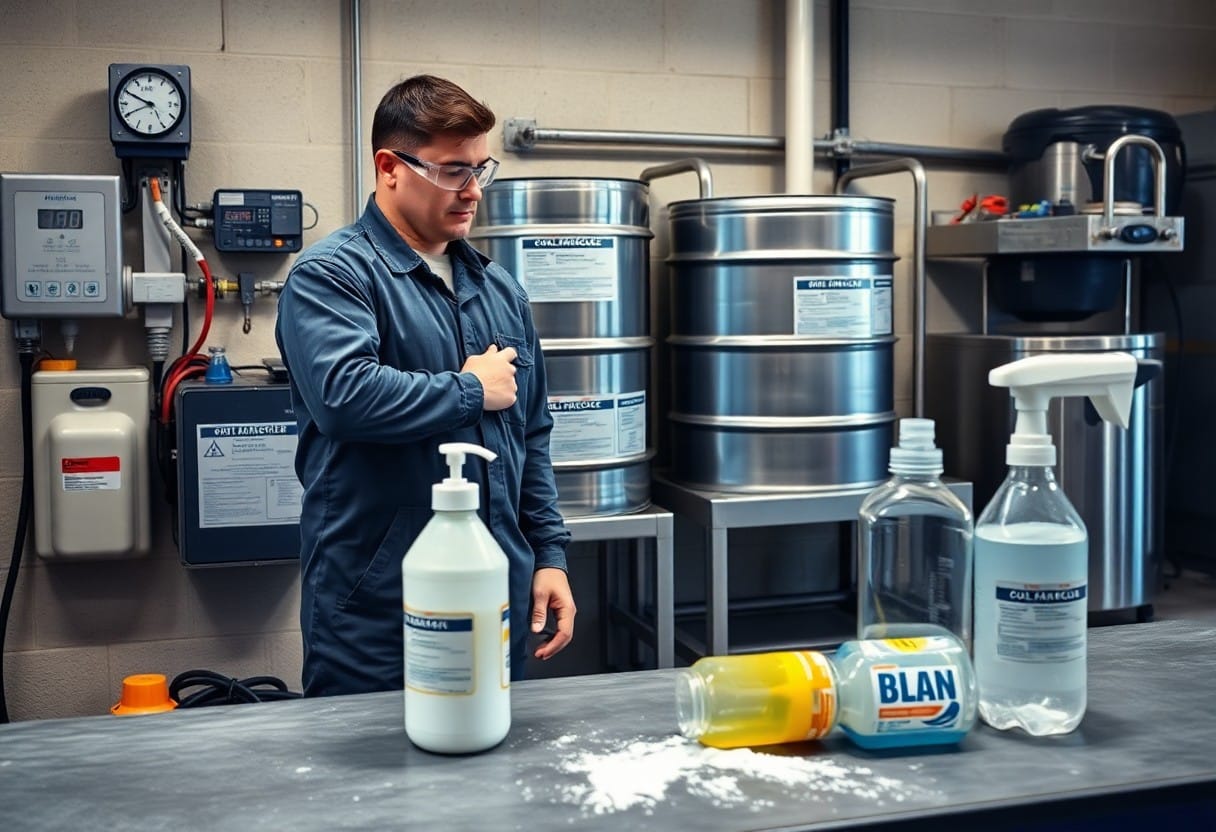
You might skip proper PPE, ventilation, or storage and expose yourself to chemical burns or fumes. Household test kits don’t instruct on safe handling, and incidents from spills or inhalation are common when people mix, pour, or transfer concentrates without containment or eyewash access.
In practice you should be using chemical-resistant gloves, splash goggles, and a respirator for acids or dry shock; store acids separate from oxidizers at stable temperatures below 25°C and in secondary containment. Professionals use closed dosing systems, SDS on-site, and spill kits with neutralizers; without those controls you increase the chance of a spill escalating into property damage, injury, or emergency room visits.
Potential for Chemical Reactions
You can unintentionally create toxic gases or fires by mixing incompatible products: bleach plus acid yields chlorine gas, while bleach plus ammonia forms chloramines. Even adding granular shock directly to low-pH water can produce heat and splattering, creating acute inhalation and burn hazards.
Thermal and violent reactions occur when oxidizers contact organic material or acids. You should note that exothermic releases can aerosolize chemicals, spreading contamination; professionals prevent this with controlled dilution rates, compatibility charts, and mechanical feeders. In emergencies they evacuate, ventilate, and call hazmat – options you may not have if a reaction occurs at home.
Miscalculation Dangers
You may misjudge pool or system volume, neglect combined chlorine, or ignore stabilizer impacts, resulting in overdosing or underdosing. Overdosing chlorine above 10 ppm can irritate eyes and lungs; underdosing allows bacteria like Pseudomonas or Legionella to proliferate, risking infections and liability.
Typical errors include using surface area instead of true water volume, not adjusting for recent rain or fill water, and relying on strip tests with ±0.5 pH variability. Professionals perform titrations, log historical trends, and program dosing pumps to precise mg/L additions; these steps avoid repeat shocks, equipment corrosion, and repair bills that often exceed $1,000-$2,000 for heater or liner damage.
Benefits of Professional Chemical Balancing
Access to Trained Professionals
You get technicians with formal training and certifications (for example, CPO courses of roughly 20-40 hours plus testing) who can spot trends in your water chemistry, interpret titration and photometer results, and diagnose issues like cyanuric acid build-up or breakthrough chloramines before they force closures or equipment damage.
Advanced Equipment and Technology
You benefit from instruments beyond home test strips: photometers that measure to 0.01 mg/L, ORP meters, automated chemical feeders, and remote-monitoring systems that give minute-by-minute readings and cut manual testing errors.
- High-precision photometers for accurate free chlorine and combined chlorine readings.
- Automated feeders and controllers to dose chemicals in 5-15 minute cycles.
- Remote telemetry that sends alerts for pH or sanitizer excursions.
Equipment vs Purpose
| Device | Primary Purpose |
|---|---|
| Photometer | Quantifies chlorine, bromine, and metals to 0.01 mg/L for precise dosing |
| ORP Sensor | Monitors oxidizing potential to indicate disinfection efficacy |
| Automated Feeder | Maintains target setpoints with timed or sensor-driven dosing |
For example, a commercial facility using automated controllers and photometers can reduce chemical overfeed and swing pH by adjusting dosing every 5-15 minutes; that continuous control often prevents scale formation and extends heater life compared with daily manual adjustments.
- Automated logs that export CSVs for audits and trend analysis.
- Redundant sensors to validate readings and flag drift before failures.
- Integration with building management to coordinate HVAC, backwash, and dosing events.
Readout vs Operational Action
| Readout | Operational Action |
|---|---|
| pH drift above setpoint | Automated acid dosing or operator alert for inspection |
| Free chlorine drop | Increase sanitizer feed and check stabilizer/organics |
| Sensor fault | Switch to redundant sensor and schedule calibration/replacement |
Regulatory Compliance
You avoid noncompliance by following local and national codes-many jurisdictions and the CDC Model Aquatic Health Code require documented testing and corrective actions at intervals such as every 2-4 hours for public pools, along with retained logs for inspections.
Professionals maintain chain-of-custody sampling, timestamped logs, and corrective-action records that inspectors expect; that reduces closure risk and helps you demonstrate due diligence if a complaint arises or an outbreak investigation occurs.
Liability Insurance Protection
You gain protection because professional firms typically carry general liability policies (commonly $1M-$2M limits) and pollution/operations coverage that can cover chemical-related injuries, property damage, and legal defense costs arising from service actions.
When a chemical incident leads to injury or equipment damage, the provider’s insurance often handles claims, settlements, and attorney fees up to policy limits, shielding you from direct financial exposure and helping ensure remediation is professionally managed.
Case Studies: Professional Versus DIY
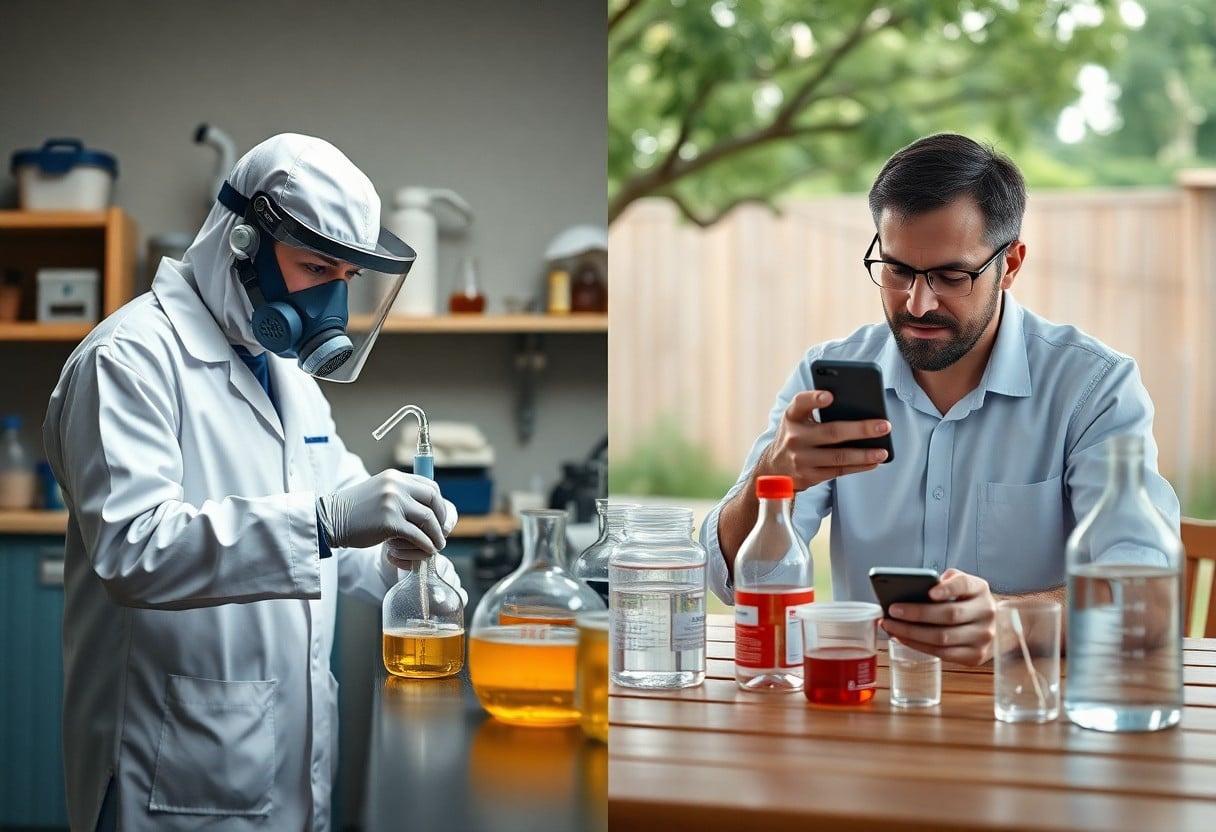
- Residential pool – pH 8.2, free chlorine 0.2 ppm, combined chlorine 5 ppm, CYA 80 ppm. You called a pro; they lowered pH to 7.4, increased FC to 3.0 ppm, and applied an oxidizing shock. Reopening time: 24 hours. Cost to homeowner: $180. DIY outcome: passive treatment for three weeks, persistent green algae, liner bleach patching cost $1,200.
- Home hot tub overdose – homeowner added three chlorine doses in 24 hours, FC spiked to ~50 ppm. You experienced coughing and one family member required an ER visit for bronchospasm (ED bill $2,400). Technician neutralized oxidizer, aerated water, and restored safe FC (3-5 ppm) within 8 hours; service fee $120.
- Municipal pool public health incident – measured FC 0.5 ppm and pH 6.6 after heavy use; one fecal event reported. When you engaged certified operators they quarantined the pool, performed hyperchlorination to 20 ppm for 8 hours, and verified log reduction; closure costs avoided were estimated at $15,000 in lost program revenue. DIY attempt would have missed protocol, increasing outbreak risk and regulatory fines.
- Indoor aquatic center – low calcium hardness (90 ppm) caused corrosion and heat exchanger failure. A pro adjusted hardness to 250-300 ppm and monitored corrosion rates; heater replacement previously needed by DIY neglect cost $8,500. Professional preventive program cost: $900 annually and extended equipment life by >5 years.
- Outdoor pool with high cyanuric acid – CYA measured 200 ppm, free chlorine 0.5 ppm (ineffective). Professionals performed partial drain (30%), dilution, and rebalanced chemistry over four days; service cost $650. DIY response of repeatedly adding chlorine wasted ~$300 in chemicals and failed to restore sanitizer efficacy.
- Plaster etching from over-acidification – owner over-corrected pH, lowering total alkalinity from 80 to 20 ppm and pH from 7.8 to 6.4 within 48 hours. You faced visible etching; plaster repair estimate $6,000. Certified techs rebalanced alkalinity and staged pH adjustments to stop further damage; emergency service charge $450.
Successful Professional Interventions
When you bring in a certified technician, they use precise tests (photometer or titration) and protocols: for example, correcting pH from 8.2 to 7.4 and raising FC from 0.2 to 3.0 ppm within 24 hours, or applying 20 ppm hyperchlorination after a fecal event to meet public‑health log‑reduction targets. That accuracy shortened downtime, limited repair costs to hundreds rather than thousands of dollars, and prevented health visits in multiple documented cases.
Consequences of DIY Mistakes
If you handle balancing without reliable testing and protocol adherence, you risk health incidents, equipment failure, and large repair bills-examples above include ER costs of $2,400, heater replacement at $8,500, and plaster repairs of $6,000. Time lost and repeated chemical waste often multiply total cost versus a one‑time professional service.
Beyond immediate expenses, your DIY errors commonly create cascading problems: overuse of oxidizers can corrode metal parts and degrade liners, under‑sanitization leads to algae and biofilms that require weeks to remove, and improper acid or alkali dosing accelerates surface wear. Professionals mitigate these chains by measuring CYA, TA, calcium hardness, and FC precisely, advising partial drains when needed, and documenting corrective actions to limit liability and recurring costs.
Cost Considerations
Initial Investment in Professional Services
You’ll typically pay $75-$200 for a first professional balancing visit that includes multi-parameter testing, precise dosing, and calibration of equipment; by contrast, buying a decent digital test kit and chemicals can cost $100-$300 upfront and still leave you guessing on dose timing and interactions.
Long-term Cost Savings
Hiring a pro can cut your annual chemical use by 15-30% and prevent scale or corrosion that shortens heater and pump life, translating to average savings of $300-$800 per year and delaying major replacements that often cost $1,000-$2,500.
For example, clients who follow quarterly professional maintenance often avoid a costly heater replacement for an extra 2-5 years; if a heater replacement is $1,500, that deferred expense plus lower yearly chemical spend can total $2,000-$4,000 saved over five years.
Comparison with DIY Expenses
You’ll find DIY starts cheaper per visit but accumulates hidden costs: over-treating, incorrect pH swings, and premature equipment wear frequently raise total spend beyond professional plans within 1-3 years.
Professional vs DIY – Typical Annual Costs
| Professional Service | DIY |
| Initial visit: $75-$200 | Test kit + starter chemicals: $100-$300 |
| Yearly chemicals & maintenance: $200-$500 | Yearly chemicals & retests: $300-$700 |
| Equipment repairs (average annualized): $100-$300 | Equipment repairs (higher risk): $300-$900 |
| Time cost: low (service included) | Time cost: higher (testing, troubleshooting) |
Using the table, you can see a common homeowner example: if DIY adds an extra $200-$400 per year in chemicals and accelerates a $1,500 repair by several years, you’ll outspend a professional service within 2-4 years while also taking on more risk and time.
When to Call a Professional
Indicators of Need for Expert Help
If you see persistent cloudy water, staining, recurring algae despite treatment, or skin/eye irritation among bathers, call a pro. Also contact one when pH consistently falls outside 7.2-7.8, free chlorine is below 1 ppm or above 4 ppm, alkalinity is outside 80-120 ppm, or you have rapid swings after dosing. Equipment failures-broken heaters, injectors, or pump cavitation-are other clear signals you need expert diagnostics and repair.
Frequency of Professional Balancing Services
Aim for professional balancing 2-4 times per year for a typical residential pool: start-up, midseason, pre-winter, plus one maintenance visit. Hot tubs or pools with heavy bather load often require monthly service; commercial and public pools usually need weekly to monthly professional attention to meet health-code testing and documentation requirements.
Seasonal events and incidents should prompt extra visits: after heavy storms, major refill, chemical shocks, or renovations. For example, a community pool with tournaments schedules pros every 2-4 weeks during peak season and quarterly otherwise, which helps stabilize pH, manage calcium hardness (target 200-400 ppm), and avoid costly corrosion or scaling repairs. You’ll reduce emergency closures and extend equipment life with proactive scheduling.
Conclusion
So you should hire a professional for chemical balancing because they test precisely, interpret results, and dose chemicals safely, reducing risk of burns, inhalation, and equipment damage; they follow regulations, use proper protective gear, and manage chemical interactions and disposal correctly, protecting your health, your pool systems, and your liability while saving you time and costly mistakes.
FAQ
Q: What training and tools do professionals have that make balancing chemicals safer?
A: Professionals receive formal training and certification on water chemistry, pathogen control, and safety procedures. They use calibrated instruments (titration kits, digital pH/ORP meters, spectrophotometers) and lab-grade reagents to obtain precise measurements that consumer test strips or single-parameter kits cannot match. Their experience lets them interpret complex results and adjust treatments for factors such as temperature, bather load, and recent maintenance events.
Q: How do professionals reduce the risk of chemical accidents during handling and mixing?
A: Technicians follow established protocols for safe storage, labeled containers, proper ventilation, and use of personal protective equipment (gloves, goggles, respirators). They separate incompatible chemicals, use secondary containment, and employ correct sequence and dilution methods to prevent heat, gas release, or violent reactions. They also carry spill kits and are trained in emergency response and first aid for exposures.
Q: Why is accurate dosing by a professional better than DIY adjustments?
A: Accurate dosing prevents under-treatment (leading to pathogens and algae) and over-treatment (causing corrosion, skin/eye irritation, cloudy water, and damage to surfaces and equipment). Professionals calculate doses from precise volume measurements, current chemical levels, and environmental variables, and may use automated feeders or controlled shock treatments to achieve stable, long-term balance rather than repeated guesswork.
Q: How do professionals manage chemical interactions and hidden contaminants that DIY methods miss?
A: Pros test for and treat compounds that common home kits miss-combined chlorine (chloramines), cyanuric acid, metals, phosphates, and organic load-which affect sanitizer performance and water clarity. They select compatible oxidizers, sequestering agents, or enzyme treatments and avoid dangerous mixes (for example, chlorine with acids or ammonia). This prevents formation of toxic gases, staining, and catalytic consumption of sanitizers.
Q: What legal, warranty, and long-term safety benefits do professionals provide?
A: Using a licensed professional helps ensure compliance with local health and safety regulations, provides documentation of maintenance for liability and inspections, and can protect equipment and surface warranties that require professional service. Pros offer scheduled maintenance, monitoring, and rapid corrective action that reduce long-term repair costs and liability from waterborne illness or property damage.