There’s significantly higher evaporation in summer because warmer air and stronger sunlight raise water temperature and vapor pressure, and wind amplifies evaporation and splash-out; increased swimming, backwashing and filter operation add usage losses, while heat can worsen small leaks as materials expand, making them more noticeable – you should run a bucket test, inspect fittings and covers to determine if your loss is evaporation or a leak.
Key Takeaways:
- Higher temperatures and lower humidity increase evaporation rates from the pool surface.
- Wind, splashing from swimmers, and water features significantly accelerate water loss.
- Frequent backwashing, leaks in plumbing or fittings, and thermal expansion can cause greater summertime losses.
- Evaporation is amplified by larger surface area and higher water temperature.
- Mitigate loss with a pool cover, windbreaks, leak checks, and limiting unnecessary backwash or fill cycles.
Understanding Pool Water Loss
Natural Evaporation
Evaporation is the top cause of seasonal loss; in summer you can expect roughly 0.25-0.5 inches per day. For example, a 16×32 ft pool (512 sq ft) loses about 80-160 gallons per 0.25-0.5″ of evaporation. Surface area drives the math: each square foot loses about 0.623 gallons per inch, so the larger your pool, the faster you’ll see visible drops on hot, dry days.
Temperature and Weather Conditions
Higher water and air temperatures accelerate evaporation, and dry air plus wind compounds it-on windy 85°F days evaporation can double compared with calm 75°F conditions. You’ll notice faster drops when humidity is below 40% and solar radiation is strong; in practical terms a hot, breezy afternoon can push loss toward 0.5″-1.0″ daily in extreme cases.
You can quantify effects by tracking daily highs, wind, and humidity; comparing two consecutive summer days often shows evaporation changing by 20-50% with a 10°F swing or added breeze, so measuring alongside weather helps you distinguish evaporation from leaks.
Temperature & Weather Effects
| Condition | Typical effect / example |
| Air temperature | Each ~10°F rise often increases evaporation ~10-20%; 75°F → 85°F can raise daily loss noticeably. |
| Water temperature | Warmer water releases more vapor; heated pools lose more than unheated ones even at same air temp. |
| Humidity | Low humidity (<40%) allows faster evaporation; high humidity (>70%) slows it significantly. |
| Wind | Light breeze (5-10 mph) increases loss; sustained wind can double evaporation compared with still air. |
| Sun/solar radiation | Direct sun heats surface and boosts evaporation versus cloudy conditions; midday peaks are common. |
Operational Factors
- You run the pump with worn seals or loose unions-a 0.5-1 gal/hour leak equals about 12-24 gallons per day.
- You may have an autofill stuck open that masks a slow leak by constantly topping off the pool.
- You backwash or leave filter/drain valves open and can dump 50-200 gallons in a single session.
- You have hidden plumbing or skimmer cracks that produce steady inches-per-week losses if not pressure-tested.
- You use solar heaters, fountains, or aggressive water features that increase surface evaporation and can conceal plumbing losses.
Pool Equipment Malfunctions
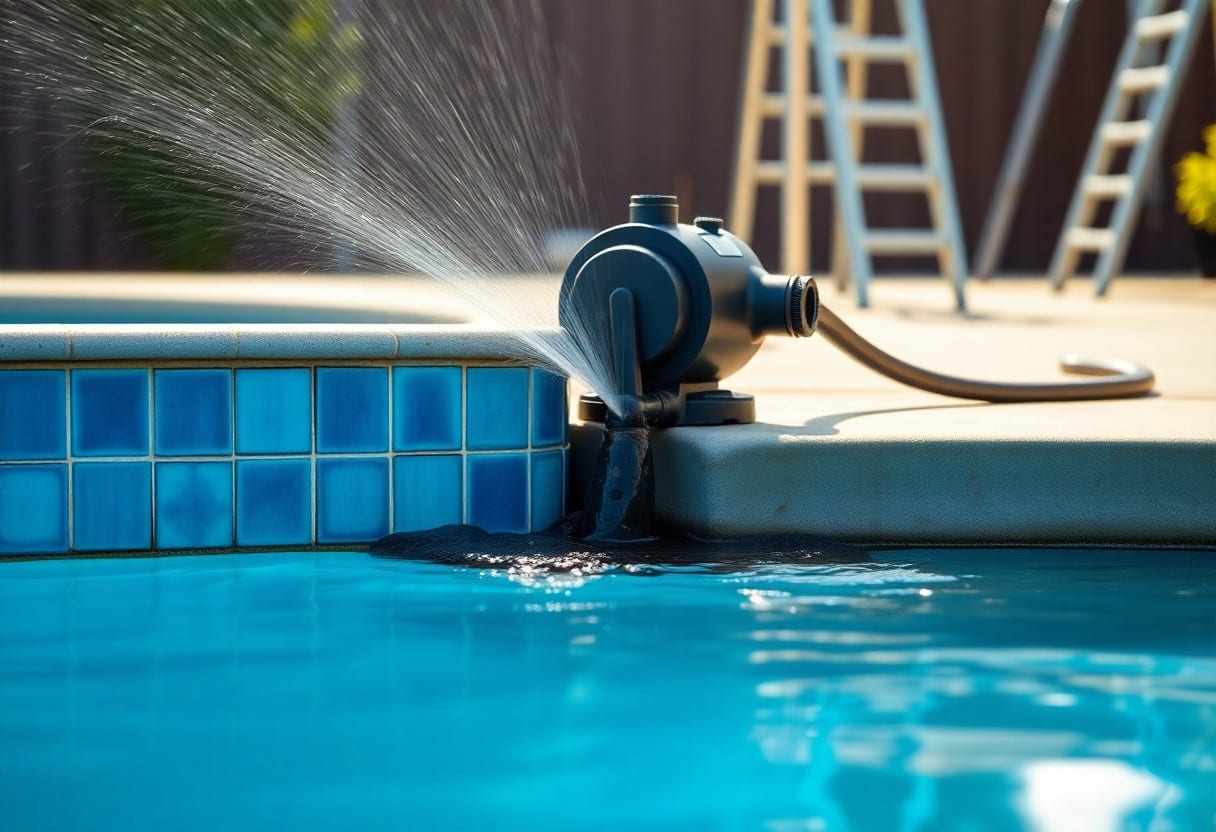
You should inspect pump seals, O-rings, union fittings and skimmer cups regularly; a failing shaft seal or loose return fitting can leak 12-24 gallons a day, and air in the pump basket often signals a suction-side leak. Run the pump briefly with the lid off to spot air, feel for wet spots around connections, and check pressure gauges for unexplained drops.
Water Chemistry
You need to keep pH in the 7.2-7.8 range, total alkalinity at 80-120 ppm and calcium hardness at 200-400 ppm because imbalance accelerates corrosion or liner shrinkage, which creates gaps at returns and skimmers that let water escape; test 2-3 times weekly in hot weather and adjust with sodium bisulfate or soda ash as needed.
Use a reliable test kit or digital meter: aim for free chlorine 1-3 ppm, pH 7.2-7.8, alkalinity 80-120 ppm, calcium hardness 200-400 ppm and keep TDS under ~1,500-2,000 ppm; when TDS climbs you may need a partial drain and refill (often 20-40% of the pool) to restore balance. Test at least twice weekly in hot weather and log results so you can link chemical shifts to sudden water loss. Any persistent loss above 1 inch per week means run a bucket test or call a leak detection pro.
Seasonal Maintenance Practices
Importance of Regular Inspections
You should inspect your pool weekly during summer: check skimmer baskets, pump seals, return fittings, tile lines and visible shell for hairline cracks or wet soil around equipment. Evaporation alone is typically 0.25-0.5 in (6-13 mm) per day, so losses greater than ~1 in (25 mm) over a week suggest a leak. Use a dye test at suspected spots and log readings to compare against expected evaporation-one homeowner spotted a 3-in (75 mm) drop in three days and found a faulty return line clamp.
Adjusting Water Levels
You should maintain the water at about the mid-point of the skimmer opening-roughly 1-2 in (25-50 mm) below the pool tile-to ensure consistent skimming and avoid pump cavitation. After heavy use, backwashing, or a storm adjust levels; a drop of more than 1 in per day should prompt investigation. Using an automatic leveler or weekly manual top-offs reduces stress on seals and heaters, and prevents the air-suction that can accelerate water loss through splashing and noisy, inefficient pump operation.
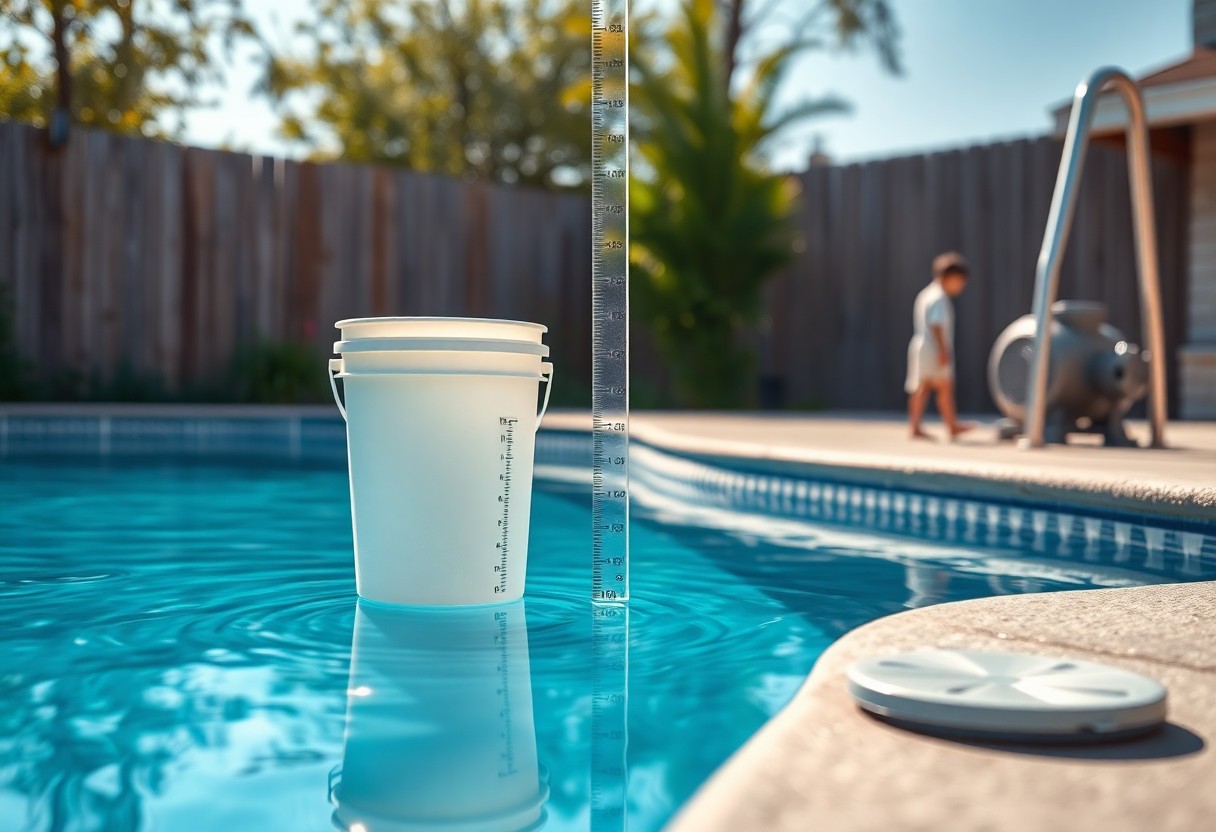
For a precise check, use the bucket test: place a weighted bucket on the first step, fill to the same level as the pool, mark both water lines, run filtration 24 hours, then compare losses; if the pool level falls more than 1/4 in (6 mm) beyond the bucket, you likely have a leak. In one HOA case the bucket lost 0.2 in while the pool lost 2.0 in in 24 hours, revealing a ruptured return line-after replacing a clamp the loss dropped to expected evaporation rates.
Unintentional Water Loss
Backwashing and Filter Maintenance
When your filter pressure climbs about 8-10 psi above the clean baseline, you typically need to backwash; a single backwash commonly uses 300-1,000 gallons (1,100-3,800 L) depending on filter size and run time. If you backwash weekly during a busy summer, that quickly adds up to thousands of gallons. Check the gauge, time the backwash (many sand filters need 2-3 minutes), and route rinse water to a drain or landscape area to avoid wasting return water.
Splashing and Water Play
With kids and guests you can lose extra water fast: heavy splashing often drains 0.25-0.5 inches per day, and on a 15×30 ft pool that equals roughly 70-140 gallons daily. Waves from running, jumping, and toys push water over the coping, and repeated activity compounds the loss. Use a marked tile or bucket test to quantify how much play is costing you each week.
For example, an adult’s submerged volume is roughly 60-80 liters (16-21 gallons), so a single cannonball can displace that much water and send a portion over the edge. If four people each produce 5-10 gallons of spillage per jump and do ten jumps in an afternoon, you’re looking at 200-400 gallons lost in hours. You can reduce that by limiting cannonballs to one area, staggering play, using floating play zones, and keeping towels or a deck drain handy; tracking loss with a visible marker ties behavior to exact water drops.
Environmental Factors
- Surrounding Landscape and Vegetation
- Climate Variability
- Wind and Exposure
- Hardscape and Reflective Surfaces
- Local humidity and microclimates
Surrounding Landscape and Vegetation
If trees or tall shrubs sit within 10-20 feet of your pool you get shade that can cut evaporation by roughly 10-30%, but you also get constant leaf litter and sap that force more backwashing and filter runs; for a 15×30 ft pool, extra backwashing once a week can cost you 10-40 gallons per session. Hardscapes like concrete or stone heat up and radiate warmth, increasing pool-surface evaporation and boosting water loss on hot days.
Climate Variability
Hot, dry summers with low humidity and sustained winds can push evaporation to 0.25-0.5 inches per day in arid regions, versus 0.1-0.2 inches in humid coastal areas; that means your pool could lose 50-150+ gallons daily depending on size, exposure, and local wind patterns. You should track local weather-temperature, relative humidity, and average wind speed-to estimate seasonal losses accurately.
Evaporation scales with surface area and conditions: a 15×30 ft pool (≈450 sq ft) losing 0.25 in/day sheds about 70 gallons daily, and a steady 10-15 mph breeze can raise that by 30-50%; solar radiation spikes on cloudless afternoons further accelerates loss. Using a solar cover typically cuts evaporation by up to 90-95%, and combining that with strategic shading or windbreaks (fences, hedges) reduces daily loss dramatically. Thou can isolate evaporation from a leak with a simple 24‑hour bucket test placed at the waterline.
Solutions to Mitigate Water Loss
Installing Pool Covers
A properly fitted cover cuts evaporation dramatically-solid safety or professional automatic covers can reduce water loss by up to 90-95%, while solar blankets typically save 70-85%. You should choose an automatic cover if daily convenience and safety matter; expect $3,500-$8,000 installed, versus $50-$300 for DIY solar options. Also use a cover pump after storms, keep edges sealed, and fit a reel system so you’ll actually use it every night.
Enhancing Backyard Landscaping
Planting windbreaks and positioning hardscaping lowers wind-driven evaporation; a 6-foot solid fence or dense hedge can cut wind speed at pool level by as much as 40%, translating to significant water savings. You can place screens on the prevailing wind side, add retaining walls, or use pergolas to reduce exposure while maintaining airflow. Aim for materials that don’t shed excessive debris.
Choose low-shedding evergreens like arborvitae or American holly for year-round protection, and situate large trees at least 15-20 feet away to minimize leaves reaching your pool. Use 3-4 foot dense shrubs as immediate wind buffers, combine with permeable pavers to limit splash runoff, and install drip irrigation to avoid overspray; over a season this approach cuts refill frequency and reduces filter maintenance.
To wrap up
Drawing together, your pool loses water faster in summer because higher temperatures, stronger sunlight and lower humidity increase evaporation, while wind and more frequent swimming create splash-out; warm conditions also expand fittings and expose small leaks. You should monitor levels, check seals and equipment, and adjust covers, circulation and chemistry to reduce loss and protect your pool’s integrity.
FAQ
Q: Why does my pool lose water faster in summer?
A: Higher air and water temperatures boost evaporation because warm water turns into vapor more quickly. Low humidity and wind increase that evaporation by carrying moisture away from the surface. Increased sun exposure and more frequent use (swimming, splashing, water features) also add to water loss, so summer conditions combine to accelerate the rate.
Q: How can I tell if the water loss is evaporation or a leak?
A: Perform a bucket test: place a filled bucket on the pool step so the water level inside matches the pool, mark both levels, run your pump and normal use for 24-48 hours, then compare drops. If pool and bucket drop the same, it’s evaporation; if the pool drops more, it’s a leak. Typical evaporation is about 1/4″-1/2″ per day, but hot, dry, windy days can push that to 1″ or more.
Q: Do normal pool activities or maintenance cause noticeable water loss?
A: Yes. Splash-out from swimmers and pets can dump many gallons per session. Backwashing a filter or draining for cleaning can remove tens to hundreds of gallons per cycle depending on flow and duration. Water features, fountains, or jets and frequent filter backwashes in summer increase total daily loss.
Q: Could pool equipment or plumbing problems be making it lose water faster in summer?
A: Yes. Heat and heavy use can exacerbate leaks in pump seals, union fittings, skimmer gaskets, return jets, valves, and cracks in liners or plaster. Pool heaters, solar systems, or automatic fills with faulty valves can also leak. Do a visual inspection for wet soil, running water sounds, pressure losses, and use a dye test around fittings and cracks to locate leaks.
Q: What steps reduce summer water loss and when should I call a pro?
A: Reduce evaporation with a solar cover or liquid evaporation reducer, add windbreaks or shade, lower pump run time where appropriate, limit splashing and water-feature runtimes, and avoid unnecessary backwashes. Fix leaking equipment, tighten or replace gaskets, and repair liner/plaster damage. Call a pool professional if the bucket test indicates a leak, if you find evidence of plumbing leaks, or if you can’t locate the source after basic checks.