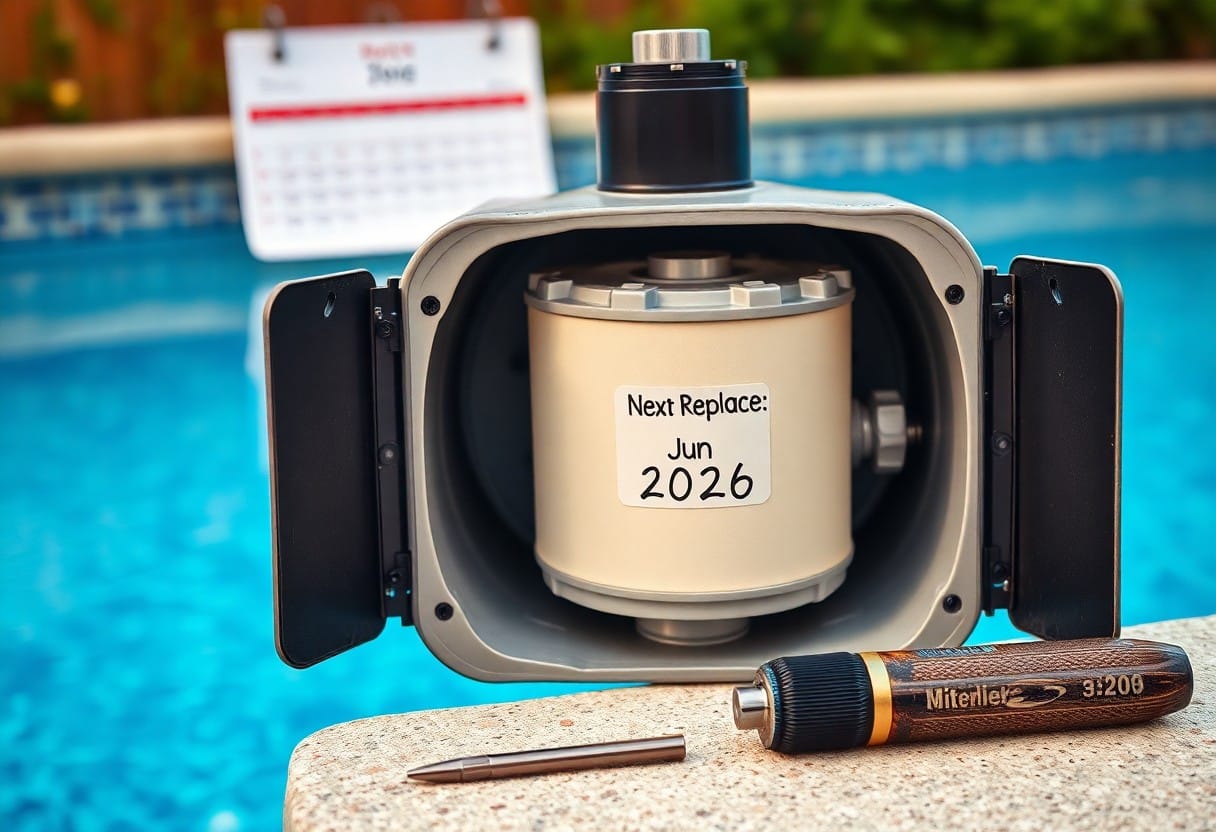
filter replacement frequency depends on filter type, pool usage, and environment; you should expect cartridge filters to last 1-3 years, DE grids 3-5 years with proper maintenance, and sand filters 5-10 years, but monitor pressure rises, reduced flow, and visible wear on your filter and replace sooner to protect water quality and equipment.
Key Takeaways:
- Replace on a schedule by filter type: sand every 5-7 years, cartridge every 1-3 years (longer with diligent cleaning), DE grids about 5-10 years depending on maintenance.
- Replace sooner if persistent high pump pressure or low water flow remains after cleaning or backwashing.
- Regular cleaning, correct backwashing, and proper water chemistry extend filter life-follow manufacturer recommendations.
- Inspect filter media annually for tears, holes, or hard-packed debris and replace any damaged or excessively worn parts.
- Record the clean baseline pressure and keep spare cartridges or grids so you can replace media as performance declines.
Understanding Pool Filters
Types of Pool Filters
You’ll encounter three main designs-sand, cartridge, and DE-each trapping particles at different sizes and requiring distinct maintenance: sand typically filters to ~20-40 μm and needs backwashing every 1-2 weeks; cartridges capture ~10-30 μm and are rinsed every 3-6 months with replacement every 2-5 years; DE removes down to ~2-5 μm and needs periodic DE top‑ups and grid cleaning. Recognizing which suits your pool volume, swimmer load, and maintenance tolerance improves water clarity and operating cost.
- Sand: robust, low initial cost, media change every 5-7 years.
- Cartridge: finer filtration, cheaper operation, elements last 2-5 years.
- DE: best microscopic filtration (2-5 μm), higher cost and maintenance.
| Sand filter | 20-40 μm; backwash every 1-2 weeks; media replacement ~5-7 years. |
| Cartridge filter | 10-30 μm; clean every 3-6 months; replace elements 2-5 years. |
| DE filter | 2-5 μm; add 1-2 cups DE after backwash; grids last 2-4 years. |
| Performance indicators | Pressure rise of ~8-10 psi over clean baseline signals cleaning or backwash. |
| Cost & lifecycle | Initial: Sand $300-$800, Cartridge $400-$1,200, DE $600-$1,500; operating costs vary by backwash frequency and chemical use. |
Function of Pool Filters
Your filter’s job is to remove solids-from leaves to submicron particles-so your sanitizer can work efficiently and your pump isn’t overloaded; filtration efficiency ranges from ~2 μm (DE) to ~40 μm (sand), and you should watch gauge pressure as a cleaning trigger (typically 8-10 psi over clean).
For example, with a 20,000‑gallon pool you aim for a full turnover in 6-8 hours, which at 8 hours requires ~42 GPM; if your filter fouls and flow drops 20-30% you’ll lose turnover and sanitizer contact time, raising algae risk. You should backwash or clean per the media type, track pressure trends weekly, and replace cartridges or media when cleaning no longer restores flow to within the normal operating range.

Signs Your Pool Filter Needs Replacement
Reduced Water Flow
When return jets sputter and surface skimming slows, you’re likely seeing reduced flow. A drop of about 30% or more from your pump’s normal gallons-per-minute-for example falling from ~50 GPM to ~35 GPM on a mid‑size system-indicates the filter is restricting water; frequent backwashing or persistently high pressure after cleaning confirms media breakdown or internal blockage.
Frequent Clogging
You notice frequent clogging when debris builds up rapidly despite regular maintenance. If you rinse cartridges every two weeks instead of monthly, backwash sand filters weekly rather than monthly, or perform DE cleanings more than twice a month, the media or pleats have likely lost efficiency and are failing to capture fine particles.
Deep, recurring clogs often come from oils, sunscreen, pollen or algae that coat pleats and DE grids, cutting filtration efficiency by 40-60%. Try a chemical soak or enzyme cleaner and a pressure rinse; for sand filters use a media cleaner or consider media replacement. If heavy clogging returns within days after a thorough clean, pleat collapse, DE grid damage, or sand channeling is likely and replacement of the element or unit is the practical next step.
Unusual Noises
Unusual grinding, rattling or high‑pitched squeals from the pump/filter area signal internal wear. When noises persist after you clear the pump strainer and remove visible debris, they often point to failing bearings, cracked laterals, or collapsing cartridges that will soon degrade performance.
Air entrainment and cavitation can also produce chattering or whistling at startup; check for loose clamps, worn seals, or low water first. If the pump sounds starved despite proper water level, inspect the impeller and filter internals-broken laterals or disintegrating pleats commonly create vibration and persistent noise. Continued abnormal sounds across multiple starts typically mean repair parts won’t suffice and replacement should be considered.
Visible Damage
Cracks in the tank, split cartridge pleats, corroded laterals, or warped end caps are clear signs you need replacement. Even hairline tank cracks let air in and tears in pleats cut filtration area immediately, reducing effectiveness.
When you spot UV‑brittled plastic, rusted clamps, or DE grids with rips, quantify the damage: a torn cartridge pleat reduces filtration area proportional to the tear, and a cracked tank larger than ~1 inch or multiple fractured laterals usually means repair costs exceed 50% of a new filter. For example, replacing all cartridges in a 48‑sq‑ft unit can cost $150-$250, while a new comparable filter runs $400-$700, often making replacement the better option.
Recommended Replacement Frequency
General Guidelines
You should generally replace cartridge filters every 2-4 years, DE filters every 3-5 years, and sand filters about every 5-10 years based on use; a pool with heavy bather load or abundant leaf litter often needs earlier replacement. If you keep water chemistry balanced and rinse or backwash regularly, you can push toward the longer end of those ranges.
Factors Affecting Replacement
Pool size, weekly bather count, surrounding foliage, pump run-time and water chemistry all change how quickly a filter wears out; for example, a busy pool with 20+ weekly swimmers and pine trees nearby may require replacement 25-50% sooner than a lightly used pool. Frequent algae blooms and pressure rises of 8-10 psi above clean baseline accelerate media degradation.
- High debris: leaves, pine needles and sunscreen increase clogging frequency.
- Heavy use: more than 10-15 swimmers per week raises particulate load.
- Poor chemistry: unbalanced pH and high combined chlorine shorten filter life.
- This leads to more frequent cleanings and earlier replacement.
You can monitor filter health by logging baseline pressure after a clean and backwashing when pressure climbs 8-10 psi; sand often needs replacement when flow drops 20-30% or visible channeling appears. Seasonal events-fall leaf fall or summer algae-can shave months off DE and cartridge lifespans, so inspect elements for tears, oil buildup or crusting.
- Check the pressure gauge weekly and note any steady upward trend.
- Rinse cartridges or backwash sand/DE when pressure rises 8-10 psi over baseline.
- Consider replacing sand every 5-7 years in high-use pools and DE/cartridges sooner if damaged.
- This practice prevents unexpected failures and preserves water clarity.
Benefits of Timely Replacement
Improved Water Quality
You’ll get noticeably clearer water when you replace filters on schedule: cartridge filters typically capture 10-15 micron particles, DE filters 1-5 microns, and sand filters 20-40 microns, so swapping worn cartridges every 1-3 years (or sooner with heavy bather load) prevents fines from bypassing the system, lowers chlorine demand, and reduces visible turbidity and algae incidents in high-use weeks.
Enhanced Energy Efficiency
Replacing a fouled filter restores proper flow and pump pressure-many systems run best around 10-20 psi-so you reduce runtime and mechanical strain; homeowners often report 15-25% shorter filtration cycles after replacing heavily clogged cartridges or backwashing DE/sand units.
If your pump is 1.5 HP (≈1.12 kW) and a dirty filter forces two extra hours of operation daily, that’s about 66 kWh/month; at $0.13/kWh you’d pay roughly $8.60/month or $103/year in extra energy. Replacing a $120 cartridge every two years can therefore lower energy use and extend pump life, offsetting replacement costs quickly.
Cost-Effectiveness
Filter replacements are relatively inexpensive-cartridges $50-$300, DE grids $80-$200, sand $50-$150-yet prevent higher costs from chemical overuse and premature pump or motor failure, so you reduce annual operating expenses while maintaining performance.
For example, spending $120 on a cartridge every two years equals $60/year; if timely replacements help you avoid a $800 pump replacement over an eight-year span, that’s a $100/year avoidance, yielding a net saving even after filter costs, plus lower chemical bills and fewer unscheduled service calls.
How to Properly Replace a Pool Filter
Evaluating Compatibility
You should match filter type, port size and flow rate: note whether you have cartridge, sand or DE, check port diameter (1.5″ or 2″), and confirm max operating pressure (commonly 30-50 psi). For cartridges, verify element length and outer diameter (examples: 4.5″x10″, 8″x20″); for sand, confirm tank diameter (18″, 24″) and multiport valve model; for DE, confirm grid count and housing fit. Picking a mismatched element can reduce flow or damage the pump.
Tools and Materials Needed
Have on hand: adjustable wrench, channel-lock pliers, Teflon tape, silicone lubricant for O-rings, replacement O-rings and clamps, new cartridge/DE grids or sand, a pressure gauge, garden hose, shop vac, gloves and a bucket. Carry spare union o-rings (common Pentair/Hayward sizes) and a small towel for spills.
Bring model-specific parts when possible: example part numbers like Hayward CX2700 cartridge or Pentair 151139 clamp help avoid returns. Use silicone grease rated for pool use (not petroleum), stock a 2″ and 1.5″ union O-ring, and keep a digital tire-style pressure gauge to verify baseline psi before and after replacement.
Tools & Materials
| Item | Notes / Typical Specs |
| Replacement element | Cartridge size (e.g., 8″x20″), DE grids or 50 lb pool sand |
| O-rings & clamps | Match housing model; have spare union O-rings (1.5″, 2″) |
| Lubricant | Silicone grease for pool O-rings, non-petroleum |
| Tools | Adjustable wrench, channel locks, shop vac, bucket |
| Measurement | Pressure gauge, stopwatch for backwash times |
Step-by-Step Replacement Process
Start by shutting off power and closing suction/return valves, then relieve tank pressure via the air-relief until gauge reads 0 psi. Disconnect unions or loosen clamps, remove the old element and inspect the housing and O-rings. Install the new element, lubricate and seat O-rings, reassemble, open valves and restart the pump. Check for leaks and confirm operating pressure sits within your normal range (often 10-20 psi).
Step-by-Step Checklist
| Step | Details / Timing |
| Power off & isolate | Turn breaker off, close valves – 1-2 minutes |
| Relieve pressure | Open air-relief until gauge = 0 psi – 30-60 seconds |
| Remove element | Loosen clamps/unions, inspect housing and weirs – 5-10 minutes |
| Install & lubricate | Apply silicone grease to O-rings, seat element, tighten clamps – 5 minutes |
| Restart & test | Open valves, start pump, check leaks and gauge; expected psi 10-20 |
| Backwash / rinse (sand/DE) | Sand: 2-3 minutes until clear; DE: backwash then add DE per filter spec |
After reassembly, run the pump and note the pressure difference: a new cartridge often drops system psi by 5-10 points versus a clogged one. Inspect for slow leaks at unions for the first 10 minutes and re-torque hand-tight clamps if needed. For sand systems, backwash 2-3 minutes or until discharge runs clear; for DE, follow your filter’s DE dosing and grid seating instructions.
Maintenance Tips for Prolonging Filter Life
- Backwash or rinse filters based on pressure rise: clean when pressure increases 8-10 psi above the clean baseline.
- Deep-clean cartridges with a dedicated filter cleaner every 3 months or after heavy bather load.
- Test water chemistry weekly and correct pH 7.2-7.6, free chlorine 1-3 ppm, alkalinity 80-120 ppm to reduce fouling.
- Keep spare O-rings, pressure gauges, and at least one replacement cartridge or a bag of DE on hand.
Regular Cleaning
You should backwash sand/DE filters every 1-2 weeks under regular use and rinse cartridge elements every 2-4 weeks; when cartridges show visible debris or the filter pressure is 8-10 psi above baseline, soak them 6-12 hours in enzyme-based cleaner and rinse thoroughly with a garden hose at moderate pressure to avoid fiber damage.
Monitoring Water Chemistry
Test your pool weekly for pH, free chlorine, total alkalinity and calcium hardness – keep pH at 7.2-7.6, chlorine 1-3 ppm and hardness below 250-300 ppm; imbalances cause scale and biofilm that clog filter media faster.
Go further by checking cyanuric acid and phosphates monthly: high stabilizer (>80 ppm) can reduce sanitiser effectiveness and raised phosphates feed algae that increase filter load. In one municipal program, lowering calcium hardness from 350 to 220 ppm cut scale-related cartridge replacements by roughly 40% over two seasons, so adjust hardness with sequestrants or partial drains when needed.
Scheduled Inspections
Inspect seals, manifolds, pressure gauges and housing monthly; replace brittle O-rings annually and swap a failing gauge immediately – a damaged seal can let air into the system and reduce filter efficiency within days.
When you log pressure readings weekly, chart trends: a steady upward trend despite backwashing suggests media exhaustion or cartridge fiber breakdown. Service steps include tightening clamp bands to manufacturer torque, checking for torn pleats under UV light, and replacing DE or sand when backwash no longer restores baseline pressure. Any routine you follow should include weekly cleaning, weekly chemistry checks, monthly inspections, and keeping spare consumables on hand.
Summing up
On the whole you should replace filter media more often than the housing: sand every 3-5 years, cartridges every 1-3 years depending on cleaning and wear, and DE grids about every 5-10 years. Replace the entire filter only if the tank is cracked, corroded, or performance doesn’t improve after media service. Monitor pressure, flow and follow the manufacturer’s guidelines.
FAQ
Q: How often should I replace a cartridge pool filter element?
A: Replace cartridge elements when they show wear or no longer clean effectively-typically every 2-4 years for residential pools. Clean cartridges every 1-3 months depending on use (rinse and use a cartridge cleaner occasionally). Signs you need replacement include frayed or collapsed pleats, mineral staining that won’t come out, persistent high filter pressure after cleaning, and reduced flow or cloudy water despite proper chemistry.
Q: How often should I replace the sand in a sand filter?
A: Replace the filter sand every 5-7 years for standard silica sand; special media (glass, zeolite) may last longer. Replace sooner if you see channeling (uneven flow), constantly rising pressure after backwashing, or cloudy water that doesn’t clear after routine maintenance. Proper backwashing frequency and avoiding oil/large debris buildup will help the sand last toward the upper end of the range.
Q: How often should I replace DE grids or elements in a DE filter?
A: DE grids typically need replacement every 2-4 years depending on care and pool use. Clean grids thoroughly after each backwash and inspect for rips, tears, bent frames, or fabric thinning. If cleaning and recharging with DE no longer restores clear water or if grids are damaged, replace them. The powder (DE) itself is replaced after each cleaning cycle.
Q: What factors change how frequently I should replace my pool filter or media?
A: Replacement frequency varies with bather load, local debris (trees, pollen), pool size, turnover rate, water chemistry control, how often you clean/backwash, and the filter’s build quality. Heavy use, high debris load, poor water balance, or infrequent maintenance shorten media life; consistent cleaning, balanced chemistry, and proper backwashing extend it.
Q: When should I replace the entire filter system instead of just the media?
A: Replace the whole filter if the tank or housing is cracked, the laterals or manifold are broken, repeated failures of internal parts occur, or the unit is older than its expected service life (commonly 7-15 years depending on type and build). Also consider replacement when repair costs approach the price of a new unit, when you need a larger capacity to meet filtration demands, or when upgrading to a more efficient technology will lower long-term operating costs.