Just as North Texas swings from blistering, low-humidity summers to sudden storms and chilly winters, your pool chemistry and clarity respond quickly; heat increases evaporation and sanitizer demand, heavy rain dilutes chemicals and brings contaminants, and cold stalls algae growth while stressing equipment-so you must monitor pH, chlorine, stabilizer, and water level after weather changes and adjust filtration, shocking, and balancing to keep your pool safe and inviting.
Key Takeaways:
- Intense North Texas summer heat and strong sun increase evaporation and UV-driven chlorine loss, accelerating algae growth and chemical consumption.
- Heavy rain and runoff dilute sanitizer and stabilizer, can lower pH (acidic runoff) and introduce organics and nutrients that spike chlorine demand.
- Windy conditions and storms deliver pollen, leaves, and dust that clog filters, raise turbidity and combined chlorine, and increase filtration workload.
- Rapid temperature swings alter chemical reaction rates and pH, promote scale formation in hard local water, and create freeze-risk during rare cold snaps.
- Regional patterns-hot, humid summers, frequent storms, and high pollen-mean more frequent testing, targeted shock treatments after weather events, and attention to TDS and stabilizer levels.
Overview of Pool Water Quality
Understanding Pool Water Chemistry
You balance pH, free chlorine, total alkalinity, calcium hardness and cyanuric acid to keep your pool safe and clear. Target ranges: pH 7.2-7.8, free chlorine 1-3 ppm, alkalinity 80-120 ppm, calcium hardness 200-400 ppm, cyanuric acid 30-50 ppm. Small shifts matter-at pH 8.0 chlorine effectiveness drops roughly 50%-so you should test weekly and after storms or heavy use.
Key Factors Influencing Water Quality
Temperature, sunlight, rain and bather load drive most water changes in North Texas: summer highs of 95-100°F increase chlorine demand and speed algae growth; strong UV degrades free chlorine unless you maintain 30-50 ppm CYA; a 1-2″ rain event dilutes sanitizer and adds phosphates from runoff. You must adjust sanitizer and filtration proactively after these events.
- Temperature spikes (95-100°F) accelerate chemical reactions and organic decay
- Heavy rain dilutes chlorine and can introduce nutrients that feed algae
- High bather load consumes sanitizer and raises combined chlorine
- Sunlight/UV breaks down free chlorine unless stabilized with CYA
- Knowing how each factor changes demand lets you schedule testing and treatments
When storms, heat waves or busy weekends hit, prioritize a sequence: test water, skim debris, run filtration 24-48 hours, then adjust chlorine and pH. For example, after a 2″ thunderstorm you may need to add 2-4 ppm free chlorine and check phosphates; during prolonged 95-100°F stretches increase run time by 25-50%. Algae can appear within 48-72 hours if free chlorine falls below 1 ppm, so you should monitor daily during high-risk periods.
- Test immediately after rain or heavy use
- Backwash or clean filter when flow or pressure indicates reduced performance
- Shock the pool when combined chlorine exceeds 0.5 ppm or after visible contamination
- Maintain CYA 30-50 ppm to protect chlorine from UV loss
- Knowing which corrective step to take first prevents longer, costlier fixes
Weather Variations in North Texas
Seasonal Weather Patterns
You face hot, humid summers with daytime highs commonly 95-100°F and winters that can drop into the 20s-30s on cold snaps; spring brings frequent severe storms, hail, and tornado risk while fall is often mild. Annual rainfall around Dallas-Fort Worth averages roughly 35-40 inches, concentrated in spring and early fall, so your pool sees cycles of heavy runoff, drought stress, and sudden influxes of debris and nutrients that change maintenance needs.
Temperature Fluctuations
You’ll notice large daily and seasonal swings: water can warm into the mid-80s-90s in summer and fall to the 40s-50s in winter, and rapid 20-30°F shifts between day and night are common. Those swings accelerate chlorine loss, shift pH, and change algae risk, so you need to monitor sanitizer and circulation more often than in milder climates.
Temperature Variation Effects
| High temperatures (≥90°F) | Increased chlorine demand, faster algae growth, higher evaporation |
| Low temperatures (≤50°F) | Slower chemical reaction rates, reduced sanitizer efficacy, lower algae activity |
| Rapid swings (20-30°F daily) | pH drift, dissolved gas changes, more frequent chemical adjustments |
| Typical guidance | Maintain free chlorine ~1-3 ppm; consider shock after several hot days or heavy use |
You should check water temperature and free chlorine daily during heat waves; when temps exceed 90°F extend circulation (many operators run pumps 8-12 hours/day in summer) and increase shock frequency-often weekly after sustained heat or heavy bather load-to keep free chlorine within target and prevent combined chlorine buildup.
Precipitation Levels
You’ll experience variable rainfall-short, intense storms in spring and fall and occasional heavy deluges-so your pool can be diluted by stormwater, overwhelmed with debris, or contaminated by runoff carrying organics and metals. Average annual totals near 35-40 inches mean you’ll need routine post-storm testing and cleanup to restore chemical balance and clarity.
Precipitation Impacts
| Light rain | Minor dilution; slight pH/FC shifts, usually corrected with small adjustments |
| Heavy storms (>0.5 in) | Significant chemical dilution, debris, turbidity, and potential CYA/metal changes |
| Runoff/flash flooding | Introduces organics, oils, and sediments that increase chlorine demand and filter load |
| Frequent storms | Raises need for more frequent testing, shock treatments, and filter maintenance |
After any significant rain you should test pH and free chlorine immediately, raise FC if it falls below 1 ppm or after visible contamination, and backwash or clean filters when turbidity rises; for storms dropping more than 0.5 inch expect to vacuum debris and consider a shock dose (per product directions) to restore sanitizer protection quickly.
Impact of Rainfall on Pool Water Quality
Dilution of Chemicals
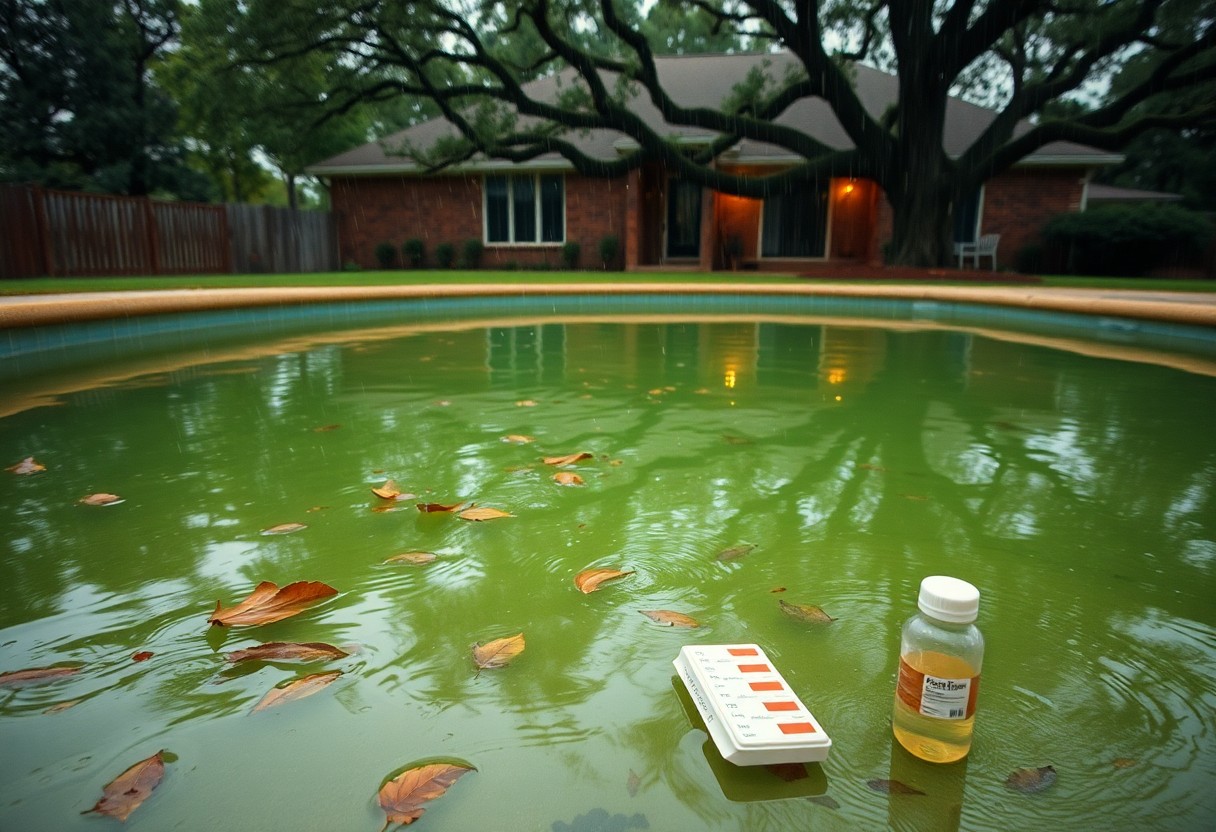
One-inch of rain on a 15×30 ft pool adds roughly 280 gallons-about 1.7% of a 16,800-gallon pool-so your free chlorine and cyanuric acid concentrations drop proportionally; light showers cause minor dilution, but 2-3-inch storm totals can reduce sanitizer levels enough that you should test and rebalance.
Introduction of Contaminants
Rainwater and runoff carry leaves, pollen, soil, fertilizer, and vehicle residues into your pool, raising turbidity and organic load; after North Texas storms you often see cloudiness and increased combined chlorine formation from these contaminants.
Runoff following thunderstorms frequently delivers fine silt, lawn chemicals, and bird droppings that boost nutrient levels and heterotrophic bacteria counts, increasing algae risk and filter loading. You’ll notice higher chlorine demand and more frequent filter backwashing; testing for combined chlorine, turbidity, and free chlorine after storms helps identify when oxidation (shock) and extra filtration are needed to restore water clarity and safety.
Balancing pH Levels
Because rain is slightly acidic (pH ~5.6), heavy or repeated rainfall can lower your pool pH by about 0.1-0.3 units, moving it away from the ideal 7.2-7.8 range and reducing sanitizer effectiveness and swimmer comfort.
Alkalinity between 80-120 ppm buffers pH swings, but sustained storms can overwhelm that buffer and force adjustments. You should test both pH and total alkalinity after significant rain; if alkalinity is low, raise it with sodium bicarbonate to stabilize pH, and if pH is off-target make small, measured corrections so you don’t overshoot and compromise plaster or metal hardware while keeping free chlorine working efficiently.
Effects of Temperature on Pool Water
Key temperature-driven effects and what you’ll observe
| Effect | What you’ll see / Impact |
| Increased bacterial growth | You’ll notice faster biofilm and algae development when water reaches mid-80s-90s°F (29-35°C), raising sanitizer demand and infection risk. |
| Faster chlorine decay | Your free chlorine will drop more quickly as reaction rates accelerate with temperature, often requiring 20-50% more chlorine during hot spells. |
| pH and alkalinity shifts | You may see pH drift upward as CO2 solubility falls and carbonate chemistry shifts; alkalinity and pH adjustments become more frequent. |
| Evaporation and water loss | You’ll lose water faster-commonly 1/4-1/2″ per day and up to 1″ in hot, windy conditions-forcing more make-up water and rebalancing. |
| Scaling and saturation changes | Your scaling risk increases as temperature affects calcium carbonate solubility and Langelier Saturation Index, especially with high hardness/alkalinity. |
| Energy and heating impact | You’ll spend less on heating in summer but may pay more to cool or reheat make-up water; temperature swings increase operational costs. |
Influence on Bacterial Growth
When your pool rises into the mid-80s-90s°F (29-35°C), microbial replication speeds up: the Q10 rule means many bacteria roughly double their growth rate for each 10°C increase. In North Texas summers that often pushes you into ranges where algae and opportunistic bacteria proliferate faster, so you’ll need to keep filtration running longer and maintain free chlorine to prevent visible blooms and increased health risk.
Chemical Reactions and Stability
Higher temperatures accelerate all chemical reaction rates, so your free chlorine breaks down faster and combined chlorine (chloramines) forms more readily; operators often find 20-50% higher chlorine consumption when water climbs from ~70°F to the low 90s°F. You’ll also see pH drift as CO2 off-gasses more quickly, requiring more frequent pH and alkalinity adjustments to keep sanitizer effectiveness steady.
Temperature changes also alter water chemistry indices: the Langelier Saturation Index shifts with temperature, increasing scaling potential as carbonate solubility changes, particularly when calcium hardness exceeds ~300 ppm and alkalinity is high. You may need to shock more often because breakpoint chlorination is harder to maintain at elevated temperatures, and you should monitor free chlorine daily during prolonged hot periods to avoid periods of insufficient disinfection.
Evaporation and Water Loss
Warmer water boosts evaporation exponentially: on calm, humid days you might lose about 1/4″ per day, but with high heat, low humidity and wind you can lose 1/2″-1″ daily. That loss concentrates dissolved solids and forces frequent make-up water, which alters alkalinity, hardness and stabilizer levels, so you’ll need to rebalance more often to preserve water quality.
To put it in perspective, losing 1″ of water from a 20×40 ft pool equals roughly 500 gallons of make-up water; if you’re losing 1/2″ per day during a heatwave, that’s ~3,500 gallons in a week. You’ll not only spend more on water and chemicals to rebalance, but replacing cooler municipal water also increases heater runtime if you maintain a set swim temperature.
Wind and its Role in Pool Maintenance
Debris Accumulation
When winds top 10-15 mph in North Texas you’ll see leaves, pollen and twigs blown into your pool rapidly; cedar and live oak seasons amplify pollen and fine debris that clogs skimmers and filters. You should plan for daily skimming after windy days and inspect baskets-after a single gusty front you can easily collect dozens of leaves and a heavy pollen film that accelerates filter load and chemical demand.
Water Temperature Regulation
Wind-driven evaporation is often responsible for over half of pool heat loss, so sustained winds of 8-12+ mph will strip heat faster and lower surface temps overnight. You’ll notice faster cooling on clear, windy nights versus still nights; that increased evaporation also concentrates chemicals, so adjust heating and sanitizer schedules around windy stretches.
To limit wind-related heat loss you can combine a solar or thermal cover with strategic windbreaks and timed heater use; covers cut evaporation dramatically, and even modest fences or hedges that block prevailing northerlies reduce convective cooling. Use your pool thermometer to compare temperature drops over several windy evenings to fine‑tune cover and heater timing for the best energy balance.
Wind vs Water Temperature: Quick Guide
| Effect | Impact / Practical Tip |
|---|---|
| Evaporation | Largest heat loss source (>50%); use a cover to retain heat and reduce chemical loss. |
| Convection | Wind transfers heat away from the surface; install windbreaks on the windward side to lower heat loss. |
| Surface Mixing | Blends warmer surface with cooler deeper water; run heaters later in the day to counter mixing losses. |
| Night Cooling | Clear, windy nights increase temperature drop; schedule covers for overnight and early-morning periods. |
Pool Cover Considerations
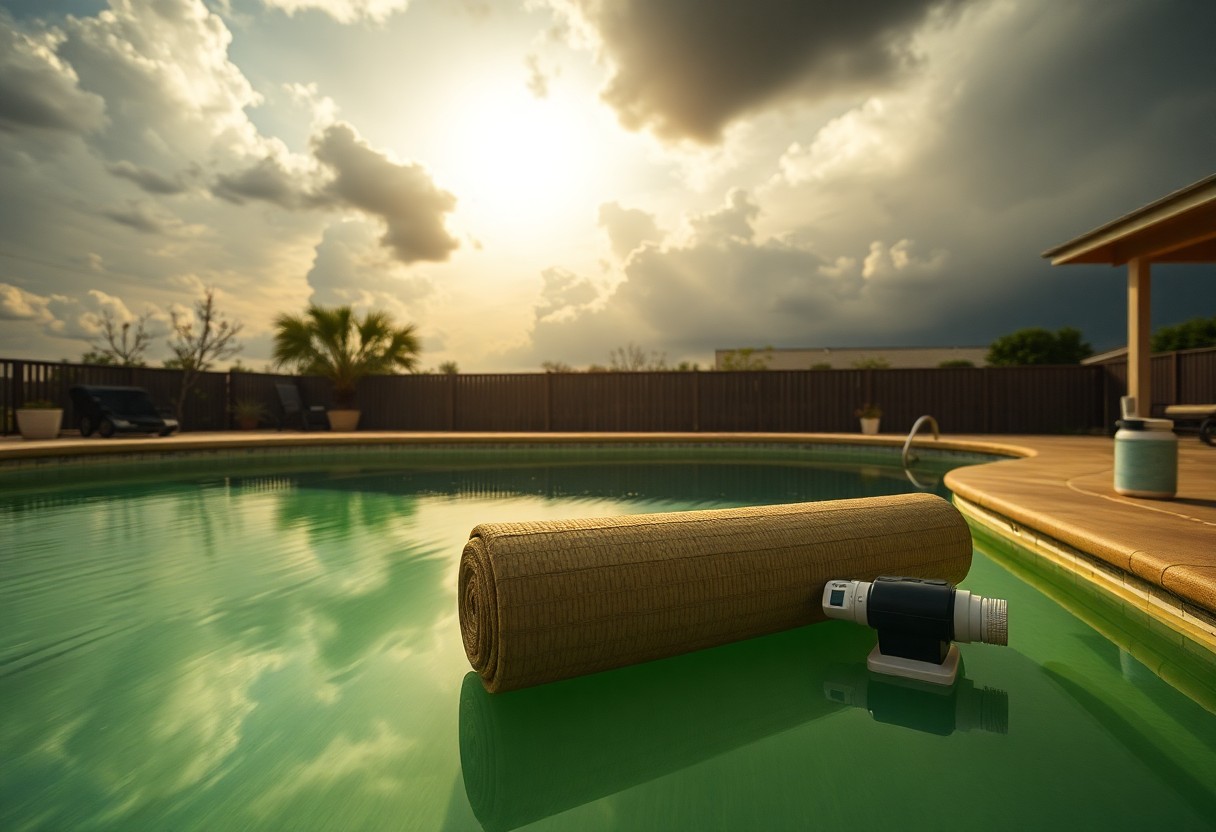
You should choose cover type based on wind exposure: solar blankets boost daytime temps (often 6-10°F) and block evaporation, while solid safety covers excel at debris exclusion but may sag under wind‑blown detritus. In high-wind yards secure covers with proper anchors and remove accumulated debris or standing water after storms to prevent damage and added load on the cover system.
Solar covers work best if you deploy them whenever the pool is idle in windy stretches-automatic reels speed deployment and reduce wear. For heavy wind corridors consider semi‑permanent windbreaks combined with a cover; liquid evaporation suppressants give minor benefit (single‑digit percentage reductions) and don’t replace a physical cover when wind is the main driver of heat and water loss.
Preventive Measures and Solutions
Regular Water Testing
You should test pH, free chlorine, total alkalinity and cyanuric acid at least twice a week in summer and within 24 hours after storms; target pH 7.2-7.8, free chlorine 1-3 ppm, alkalinity 80-120 ppm and CYA 30-50 ppm, and send a sample to a certified lab monthly to catch metals or contaminants.
Appropriate Chemical Adjustments
You can correct low pH with sodium bisulfate or muriatic acid and raise alkalinity with sodium bicarbonate; shock weekly or after heavy use-commonly 1 lb calcium hypochlorite per 10,000 gallons-and aim for a short-term free chlorine spike of 3-5 ppm during shock treatments before retesting.
Balance in steps: raise total alkalinity to 80-120 ppm first since it stabilizes pH, then adjust pH to ~7.4 and wait 4-6 hours before adding large chlorine doses; after North Texas storms increase chlorine by 2-4 ppm and run the pump 12-24 hours, brush surfaces to dislodge organics, and add CYA to 30-50 ppm if sunlight is rapidly depleting sanitizer.
Maintenance Tips for Variable Weather
You should increase filtration runtime during heat spells to 10-14 hours, backwash when pressure is 8-10 psi over baseline, cover the pool during hail or heavy debris events, and clear skimmers immediately after storms to prevent load spikes in the system.
- Test within 24 hours after heavy rain
- Run filter 12-16 hours during heat waves
- Brush and vacuum weekly to prevent algae buildup
- You should store shock and stabilizer for fast dosing
Keep a maintenance log noting test results, chemical doses and weather events so you can spot trends-North Texas summers push water toward 80-90°F requiring extra sanitizer, while spring thunderstorms dilute chlorine and increase turbidity; inspect equipment quarterly and replace filter media when flow drops 15-20%.
- Keep a 24-hour checklist for storms: test, skim, run pump
- Inspect seals, pump baskets and pressure gauges monthly
- Maintain a spare 10-20 lb supply of sanitizer for peak season
- You should note weather-related adjustments in your log
To wrap up
On the whole, North Texas weather – intense sun, heat, sudden storms, and wind – accelerates chlorine loss and evaporation, raises sanitizer demand, introduces debris and runoff that shift pH and add contaminants, and encourages algae; you should test and adjust your chemistry frequently, run filtration longer after storms, skim and backwash as needed, and maintain proper circulation to keep your pool clear and safe.
FAQ
Q: How does North Texas heat and sun affect pool chemistry?
A: High temperatures and strong sun increase evaporation, concentrate dissolved solids and chemicals, and accelerate chlorine breakdown. Warmer water speeds up chemical reactions and microbial growth, raising sanitizer demand and the likelihood of algae blooms; cyanuric acid (stabilizer) helps protect chlorine but can become depleted or diluted by topping off. To compensate, increase circulation and testing frequency, add sanitizer more often, and monitor stabilizer and total alkalinity.
Q: What impact do heavy rains and thunderstorms have on pool water quality?
A: Rain dilutes sanitizers and alters pH (often lowering it), while storm runoff introduces organics, nutrients, and debris that consume chlorine and raise turbidity. Sudden dilution can also change total alkalinity and calcium hardness readings, making chemical levels unstable. After storms, clear visible debris, test and rebalance sanitizer and pH, and consider a shock treatment if combined chlorine or cloudiness is present.
Q: How do wind, dust, and pollen common in North Texas affect pools?
A: Wind transfers leaves, dust, pollen, and lawn chemicals into pools, increasing filter load and adding phosphates and organics that fuel algae and increase chlorine demand. Filters, skimmers, and pumps must work harder; if not maintained, water can become green or cloudy. Regular skimming, frequent filter cleaning/backwashing, and proactive sanitizer management reduce these impacts.
Q: How do temperature swings and occasional cold snaps influence water quality and equipment?
A: Rapid temperature drops slow chemical reaction rates and biological activity, which can temporarily reduce chlorine demand but also cause cloudy water as dissolved gases and minerals precipitate. Freezing nights can stress plumbing and equipment-pipes and heaters are vulnerable when temperatures fall below freezing. Maintain adequate sanitizer, protect or winterize equipment when forecasts predict freezes, and confirm circulation to prevent localized freezing.
Q: After extreme weather (heatwaves, storms, dust events), what steps should North Texas pool owners take?
A: Test free chlorine, combined chlorine, pH, total alkalinity, and cyanuric acid immediately; clean skimmers and filters and backwash or deep-clean cartridges as needed. Run the pump longer, shock if chlorine is low or if contaminants are present, and remove debris promptly to prevent algae. Monitor levels daily for several days after the event and adjust dosing and run time until readings stabilize.