Over scorching Texas summers, you should reduce evaporation and chemical loss by running your pump during cooler hours, using a solar or mesh cover, and adding shade with umbrellas or sails; maintain circulation and filtration, test and adjust chlorine and pH daily, clean filters frequently, and top off water to keep levels stable so your pool stays clean, safe, and energy-efficient through extended heat waves.
Key Takeaways:
- Run the pump and filter longer (10-12+ hours/day) and clean/backwash filters often to maintain circulation and prevent algae.
- Test and balance water daily-keep chlorine, pH (7.2-7.6), total alkalinity, and cyanuric acid within target ranges to combat fast sanitizer loss in heat.
- Use a solar cover or liquid blanket and add shade (sails, umbrellas) to reduce evaporation, slow heating, and cut chemical depletion; cover the pool at night.
- Top off evaporation with fresh water and inspect for leaks; maintain the skimmer-level to protect pumps and skimmer operation.
- Shock regularly and use algaecide as needed; keep pump and equipment shaded and ventilated, and consider timers or variable-speed pumps for efficient operation.
Understanding Texas Heat Waves
Definition and Characteristics of Heat Waves
You should expect Texas heat waves to be multi-day events: typically three or more consecutive days with highs 10°F or more above seasonal norms or persistent readings above 95-100°F. Heat index values frequently climb past 105°F in urban areas, humidity amplifies stress on water and equipment, and prolonged solar radiation drives pool-surface temperatures well above ambient air.
Historical Patterns of Heat Waves in Texas
Over recent decades you’ve seen heat waves become more frequent and longer, with summers producing multiple spells of triple-digit highs. Notable cases include the 2011 multi-week heat and drought that affected much of the state, and several post-2010 summers where cities like Austin and Dallas logged repeated 100°F-plus stretches.
Scientific assessments attribute much of this shift to rising baseline temperatures: warming trends documented in regional climate data mean the threshold for a heat wave is crossed more often. You’ll observe more consecutive days above 95-100°F, higher nighttime minima that reduce pool cooling, and climate models projecting continued increases in frequency and intensity through mid-century without strong emissions reductions.
Effects of Prolonged Heat on Swimming Pools
Prolonged heat accelerates evaporation-expect roughly 1/4 to 1 inch of water lost per day depending on wind and humidity-raising water chemistry concentrations and forcing more frequent top-offs. You’ll notice faster chlorine depletion, pH drift upward, and higher water temperatures that encourage algae and bacterial growth if filtration and sanitation aren’t increased.
Equipment and surface impacts also follow: heater and pump runtimes often rise as you run filtration longer, filters clog sooner from increased bather load and organic growth, and liners or plaster can show wear from repeated thermal expansion. You may see scaling or salt concentration issues as evaporation concentrates dissolved solids, so monitoring total dissolved solids and adjusting maintenance intervals becomes more important during multi-week heat events.
Importance of Pool Protection
Preventing Water Evaporation
During Texas heat waves your pool can lose 0.25-0.5 inches of water per day, which adds up to 2-4 inches weekly and raises refill costs and salt or chemical concentrations. Using a solid or solar cover can cut evaporation by up to 90%, while windbreaks, shade sails, and running the pump at night further reduce loss. If you face municipal watering limits, a cover plus an automated autofill controller avoids repeated manual top-offs and keeps your water level compliant and stable.
Reducing Chemical Imbalance
High temperatures speed chlorine depletion and shift pH, so you must test daily during heat waves; maintain free chlorine at 1-3 ppm and pH around 7.2-7.6, with cyanuric acid in the 30-50 ppm range for outdoor pools. You’ll often need to shock more frequently-typically once or twice weekly under intense heat or heavy bather load-and run filtration longer to keep sanitizer distributed evenly through the pool.
Heat accelerates chemical reactions and UV breaks down hypochlorous acid, so stabilizer (CYA) helps preserve chlorine under strong sun. For example, during a week of 95-105°F highs, many backyard pools require additional chlorine feeds and 8-12 extra filtration hours; automated chlorinators or daily liquid chlorine additions can prevent wide swings. Track total alkalinity (80-120 ppm) and adjust before shocking, since low alkalinity makes pH bounce and reduces sanitizer effectiveness.
Minimizing Algae Growth
Warm, stagnant water allows algae to bloom in 24-48 hours, so you should maintain continuous circulation, brush surfaces daily, and run filters 10-12 hours/day during heat waves. Keeping free chlorine within 1-3 ppm, using a weekly preventative algaecide, and cleaning skimmer baskets and pump hair traps stops nutrients from accumulating and starving algae of what it needs to explode into a bloom.
If you detect green or cloudy water, act fast: test and correct pH, then apply a shock to raise free chlorine to shock levels (commonly 5-10+ ppm depending on product), brush all surfaces vigorously, and run the filter continuously until clarity returns. Backwash or clean the filter more often during an outbreak, and use a clarifier or flocculant if fine particles overload the filter-this combined approach clears algae faster and reduces repeat blooms.

Strategies for Protecting Your Pool
Using Pool Covers
You can cut evaporation and chemical loss dramatically by using a cover: solar covers can reduce evaporation by up to 95% and raise water temperature 6-10°F, while mesh or solid safety covers block debris and shade-sensitive algae. Anchor automatic covers against gusts and remove standing water after storms; for example, an automatic cover installed on a 20,000-gallon pool typically pays back in lower chemical and heating costs within 2-3 seasons.
Maintaining Water Level
Keep your water at the midpoint of the skimmer opening so pumps and skimmers operate properly; check levels weekly during heat waves and top up with a garden hose or an automatic fill valve. Low water can introduce air to the system and reduce circulation; high water can impair skimming and let debris float under the cover.
In Texas heat, evaporation can reach roughly 0.25-0.5 inches per day on hot, windy days, meaning several inches lost in a month. You should set an automatic fill with a float valve or smart controller tied to a rain sensor to avoid overfilling after storms. Inspect the fill mechanism monthly and log level changes to spot leaks early-small continuous losses often signal plumbing or seal issues that get worse under high pump run times.
Regular Cleaning and Maintenance
You should empty skimmer and pump baskets every 2-3 days in heavy use, brush walls 2-3 times weekly, and vacuum at least once a week; test pH and free chlorine daily during heat waves and keep chlorine 1-3 ppm and pH 7.2-7.6. Backwash sand/DE filters when pressure rises 8-10 psi above clean baseline or clean cartridge filters every 4-6 weeks.
Increase circulation to 10-14 hours per day in sustained heat and inspect filter pressure each week-higher run times increase filter loading, so plan more frequent cleanings. Use shock treatments weekly or after heavy bathing, maintain cyanuric acid around 30-50 ppm to protect chlorine from UV, and consider an algicide or enzyme product as a preventive step when temps exceed 90°F.
Chemical Balance Management
Testing Water Chemistry
You should test daily during a heat wave using a liquid test kit or digital meter for best accuracy; target pH 7.2-7.6, free chlorine 3-5 ppm, total alkalinity 80-120 ppm and cyanuric acid 30-50 ppm for outdoor pools. Test after heavy use, rain, or when temperatures spike, and log results so you can spot trends-stray pH or rising combined chlorine signals action is needed.
Adjusting pH and Chlorine Levels
If pH is above 7.6 lower it with muriatic acid or sodium bisulfate; if below 7.2 raise it with soda ash, following product labels and adding incrementally. Maintain free chlorine 3-5 ppm during extreme heat, and shock with a non-stabilized oxidizer (e.g., calcium hypochlorite or chlorine granules) when FC dips or after heavy use; run the pump at least 4 hours after dosing.
To remove chloramines aim for breakpoint chlorination: raise free chlorine to about 10× the combined chlorine level (example: if combined chlorine is 0.5 ppm, bring FC to ~5 ppm briefly). Also note pH affects chlorine efficacy-at pH 8.0 the active hypochlorous acid fraction falls significantly-so correct pH before expecting chlorine to work. When shocking, calculate dose from product available chlorine, add in the evening to limit UV loss, and circulate until readings stabilize.
Importance of Algaecides
You should use an algaecide weekly as a preventive measure during prolonged heat; common maintenance doses for polyquats are about 1-2 oz per 10,000 gallons weekly, though you must follow the label. Algaecides supplement chlorine, especially when temperatures and nutrient load make blooms likely, and help keep filamentous or green algae from gaining a foothold between shocks.
When algae appears, pick the right class: copper-based products are effective on green algae but can stain plaster and raise copper levels, while polyquats and quaternary ammonium products are broad-spectrum and non-staining. For mustard or black algae combine targeted algaecide treatment with brushing, vacuuming, and breakpoint chlorination; consider rotating algaecide chemistry to prevent resistance and test metal levels before repeated copper use.
Utilizing Technology for Protection
Automated Pool Covers
Automated covers deploy at the push of a button and can reduce evaporation by up to 95%, cutting water loss that in Texas can reach 1/4-1/2 inch per day; you’ll also see lower chemical use and heating demand, plus less debris and safer pool access when the cover is in place on a timed schedule.
Smart Pool Monitors
Continuous monitors track pH, ORP (sanitizer), temperature and salinity in real time, sending alerts to your phone so you can correct drift within hours instead of days; you can pair many units with automation systems to dose chemicals or change pump runtime automatically.
Installation varies-some models clip to a skimmer, others float or wire into the filtration return-and sampling rates commonly range from every 15 minutes to hourly, with battery life of 6-12 months or wired options; choose sensors with calibration routines and optional NIST-traceable accuracy if you want lab-grade consistency and fewer manual tests.
Pool Heating and Cooling Systems
Heat pumps, chillers and surface cooling devices give you control during heat waves: you can target 78-82°F for lap swimming or 82-86°F for recreation, and cooling systems help avoid temperatures above 90°F that stress equipment and make disinfection harder.
Practical choices include surface aerators or fountains that can shave 2-4°F through evaporative cooling, and mechanical chillers-sized in tons where 1 ton ≈ 12,000 BTU/hr-capable of removing tens of thousands of BTU per hour; pair these with a variable‑speed pump and run filtration 8-12 hours/day to maximize temperature control and energy efficiency.
Additional Tips for Pool Owners
- Use a solid or solar cover when the pool is idle – a cover can cut evaporation up to 95% and retain heat overnight.
- Run filtration 8-12 hours daily, preferably overnight, to keep water clear while avoiding peak daytime evaporation.
- Test water daily during heat waves and keep free chlorine around 1-3 ppm; test more often after heavy bather use or storms.
- Inspect equipment weekly-heat accelerates wear on pumps, seals, and hoses, and early fixes cost less than replacements.
- Check local permitting and HOA rules before adding permanent structures or changing setback lines.
Landscaping for Shade
You can position large shade trees 15-25 feet from the pool to lower direct sun exposure while limiting leaf litter; drought-tolerant Texas species like live oak or cedar elm perform well and need less irrigation. Plant windbreak shrubs to reduce evaporation by up to 30%, install root barriers to protect plumbing, and avoid fruiting trees that increase debris and maintenance.
Installing a Shade Structure
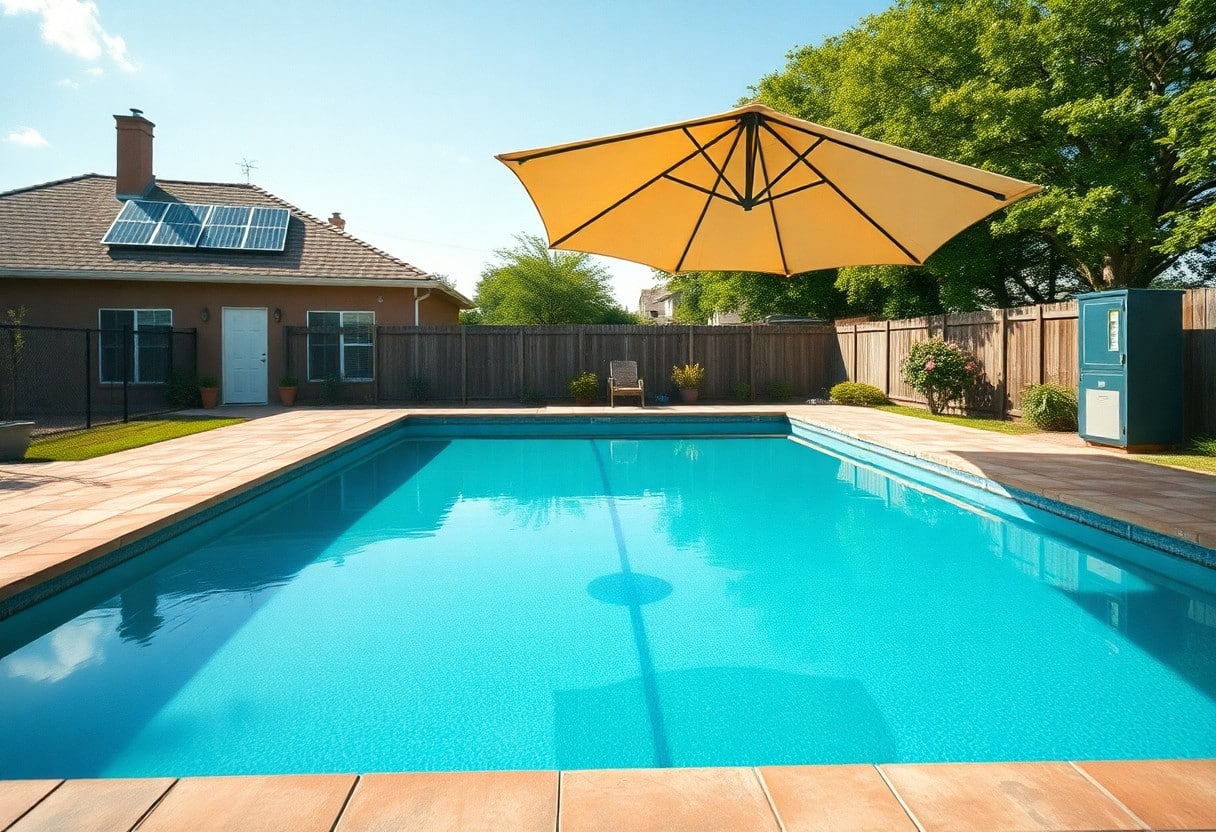
Choose from umbrellas, shade sails, louvered pergolas, or cantilevered canopies depending on permanence and budget; fabrics rated for UV protection can block 90-98% of UV and lower perceived temperature 8-15°F near the water. Expect sails and umbrellas from about $200-$1,000 and permanent pergolas from $3,000-$10,000, with variation by size and materials.
When you select a structure, factor in prevailing wind speeds-many Texas areas see 20-30+ mph gusts-so use wind-rated anchors or removable mounts. Prefer corrosion-resistant hardware (stainless steel or galvanized) around pool chemistry, and consider louvered aluminum for adjustable shade and faster water shedding compared with wood. Confirm local setback and permit requirements, plan for electrical needs if you add lighting or fans, and size the footprint to cast shade over seating and shallow areas where users rest.
Scheduling Pool Use During Cooler Hours
Shift swim times to early morning (6-10 a.m.) and evening (after 7 p.m.) to avoid peak solar radiation from about 11 a.m. to 4 p.m., when water temperature and UV exposure are highest. Schedule heavy maintenance like vacuuming or backwashing during cooler periods and set family swim windows to minimize midday heat exposure.
For planning, note that pool water can climb into the mid-to-high 80s (°F) during hot afternoons, increasing heat stress and chemical demand; tracking daily highs helps you choose safe windows. Stock shaded recovery areas and provide water breaks for children and elderly users, and time chlorine additions for evening so sunlight does less immediate breakdown of sanitizers. Assume that you avoid swimming when the heat index exceeds 105°F or during official heat advisories to reduce risk of heat-related illness.
Conclusion
Summing up, you should protect your pool during Texas heat waves by keeping filtration and circulation consistent, running the pump during cooler hours, using a solar or liquid cover to reduce evaporation, stabilizing pH and sanitizer levels with frequent testing, adding shade, topping off water as needed, and inspecting equipment and filters regularly to prevent algae and system strain.
FAQ
Q: How should I manage evaporation and water level during Texas heat waves?
A: Check the water level daily and keep it near the middle of the skimmer opening so the pump stays primed. Use an automatic fill valve or add water with a hose when levels drop. Install a solar or solid pool cover when the pool is not in use to cut evaporation by up to 90% and reduce chemical loss. Avoid overfilling; leave room for splash and thermal expansion.
Q: How often should I test and adjust pool chemistry in extreme heat?
A: Test at least 2-3 times per week during heat waves and after heavy use or storms. Maintain free chlorine around 2-4 ppm, pH 7.2-7.6, total alkalinity 80-120 ppm, and cyanuric acid 30-50 ppm for outdoor pools. Shock the pool weekly or whenever combined chlorine rises above 0.5 ppm or after heavy bather load. Store chemicals in a cool, dry place and add chemicals following manufacturer instructions to avoid overdosing.
Q: How long should I run my pump and filtration system when temperatures spike?
A: Aim for at least one full turnover of the pool volume per day; in extreme heat run 12-16 hours daily or increase runtime to achieve two turnovers if the pool is heavily used. Run the pump longer at lower speed if you have a variable-speed pump to improve filtration efficiency and save energy. Check filter pressure and backwash or clean when pressure rises about 8-10 psi over the clean baseline; clean skimmer and pump baskets daily.
Q: Are pool covers, shade, or other physical protections effective during heat waves?
A: Yes. Solar covers reduce evaporation and help retain heat at night while cutting chemical loss; solid covers provide even greater evaporation control. Shade structures, umbrellas, or trees reduce direct sun exposure and UV-driven chlorine loss, lowering chemical demand and slowing water temperature increases in sitting areas. Consider daytime shade over shallow areas and use covers whenever the pool is unused for extended periods.
Q: What steps protect pool equipment and prevent algae or other problems in high heat?
A: Keep pump, filter, and heaters shaded and elevated from direct ground heat and debris; ensure good airflow around equipment and inspect for overheating or leaks. Maintain consistent sanitizer levels and brush/vacuum surfaces weekly to prevent algae growth. Use an algaecide as preventive if algae has been a recurring issue, and service seals, O-rings, and the salt/chlorinator cell per manufacturer schedules. Have a trusted tech inspect the system before and after prolonged heat to catch stress-related wear early.