
Just stay on top of water balance, regularly test and adjust pH, alkalinity and calcium hardness, keep filtration and circulation running, use a sequestering agent when hardness spikes, brush surfaces to remove buildup early, perform routine scale removal and schedule professional inspections to address persistent issues-these actions help you prevent unsightly calcium deposits in your McKinney pool and extend equipment life.
Key Takeaways:
- Test and balance water weekly: keep pH 7.4-7.6, total alkalinity 80-120 ppm and calcium hardness 200-400 ppm; monitor Langelier Saturation Index near 0 to avoid scaling.
- Use a commercial scale inhibitor or sequestering agent when filling with hard McKinney water or during seasonal hardness spikes.
- Maintain strong circulation and filtration, run the pump daily, and backwash/clean filters regularly to prevent mineral buildup.
- Brush tile lines and pool surfaces weekly and remove developing deposits promptly with a pumice, brush, or appropriate descaler to prevent hardening.
- Control water temperature and limit unnecessary heating; consider pre-treating fill water with a water softener or blending with softened water to reduce incoming hardness.
Understanding Calcium Deposits
What Are Calcium Deposits?
Calcium deposits are hardened calcium carbonate left behind when pool water becomes oversaturated; you’ll spot them as white crusts on tile, plaster, and steps. They form when calcium hardness exceeds ~200 ppm or when pH climbs above 7.8, reducing solubility. In McKinney’s warm months, higher water temperature accelerates precipitation, so you’ll often see scale appear first around return jets, heater outlets, and shallow edges.
Causes of Calcium Deposits in Pools
High calcium hardness, elevated pH, and high total alkalinity all push calcium out of solution, and you’ll notice scale where evaporation concentrates minerals-shallow ends and near waterfalls. Poor circulation and clogged returns create local oversaturation; heaters and solar covers raise water temperature above 80-85°F, further encouraging precipitation. Your source water (well or municipality) can already contain 200-400 ppm calcium, so top-offs matter.
In practice, McKinney pools often spike after summer refills or heavy splashing: if your hardness reads over 300 ppm and pH sits near 8.0, scale forms quickly. You can test hardness with a Taylor kit and track trends weekly; pools with heaters or water features typically require sequestering agents or periodic acid treatments to control buildup.
- High calcium hardness (>200 ppm) increases precipitation risk.
- Elevated pH (>7.8) and alkalinity shift balance toward scaling.
- High water temperature (above 80°F) speeds chemical reactions that form deposits.
- Poor circulation and filtration create local hotspots where minerals concentrate.
- Recognizing dead spots and evaporation-prone areas lets you target fixes.
| High calcium hardness | Causes oversaturation; you’ll see scale when readings exceed ~200 ppm |
| High pH/alkalinity | Reduces calcium solubility; values above 7.8 promote precipitation |
| Elevated temperature | Water >80°F accelerates deposition at heaters and shallow areas |
| Evaporation and refill | Concentrates minerals; frequent top-offs with hard water worsen scale |
| Poor circulation | Creates localized saturation at returns, steps, and pool corners |
Types of Calcium Deposits
You’ll encounter several deposit types: hard, crystalline scale that bonds to plaster; soft, powdery calcium that wipes away; nodular “pitting” formations; tile-ring buildup at the waterline; and white cloudy deposits on vinyl. Each type forms under different chemical and physical conditions, and you’ll choose treatment-acid wash, sequestering agents, or mechanical removal-based on the deposit’s hardness and location.
Hard crystalline scale often requires acid-based etching or professional hydroblasting, whereas soft deposits respond to brushing and chelating agents. Nodules embedded in plaster may need grinding or spot replastering. If your tile rings form repeatedly, reduce evaporation, lower pH, and add a phosphate remover or sequestering agent to prevent recurrence.
- Hard crystalline scale: dense, raises plaster texture, resists brushing.
- Soft deposits: powdery, removable with brushing and sequestrants.
- Nodular growths: small, cement-like lumps that can pit plaster.
- Tile-ring buildup: concentrated at the waterline from evaporation.
- Recognizing the deposit type guides whether you use acid wash, sequestering, or mechanical removal.
| Hard crystalline scale | Looks like white/gray crust; treat with acid wash or professional removal |
| Soft calcium deposits | Powdery residue; responds to brushing and chelating agents |
| Nodules/pitting | Raised lumps or holes in plaster; may require spot repair |
| Tile-line rings | Brown/white ring at waterline from evaporation; clean and control chemistry |
| Vinyl surface deposits | White hazing on vinyl; use gentle cleaners and balance water to prevent return |
The Chemistry of Pool Water
Importance of pH Levels
Your pool pH should sit between 7.2 and 7.6; when it climbs above about 7.8 chlorine efficacy drops sharply and calcium carbonate begins to precipitate, creating scale on plaster and tile. Test at least twice weekly in summer, and correct high pH with muriatic acid or sodium bisulfate – for example, lowering pH from 8.0 to 7.6 in a 20,000‑gallon pool typically requires roughly 1-2 pints of muriatic acid, adjusted by test results.
Role of Total Alkalinity
Total alkalinity (TA) acts as the buffer for pH and should be kept near 80-120 ppm to prevent rapid swings; low TA causes pH bounce after additions, while very high TA can lead to “pH lock” and favor scaling when calcium and pH are elevated. Test weekly and treat based on volume and test strips or a drop test for accuracy.
To raise TA, add sodium bicarbonate – about 1.4 pounds per 10,000 gallons raises TA roughly 10 ppm. To lower TA you add acid (muriatic or dry), dose slowly, and aerate to bring pH back up afterward; check TA again 6-24 hours post‑treatment. Also monitor TA alongside calcium hardness and calculate the Langelier Saturation Index (LSI): TA plus high calcium at high pH quickly pushes LSI positive and causes scaling.
Hardness of Water
Calcium hardness should generally be 200-400 ppm for plaster or concrete pools; when hardness exceeds about 400 ppm you increase the risk of scale formation, especially if pH and TA are high. In McKinney, municipal source water often runs toward the higher end, so test monthly and treat proactively.
If you need to raise hardness, use calcium chloride per manufacturer directions; if you need to lower it, dilution with fresh water is the only long‑term fix, while sequestrants or scale inhibitors provide short‑term control. Track hardness changes after drain‑and‑fill or chemical additions, and factor hardness into LSI calculations to predict scaling versus corrosive conditions.
Routine Maintenance to Prevent Deposits
Regular Water Testing
Test your pool water at least twice weekly during summer and weekly in cooler months, measuring pH, total alkalinity, calcium hardness and cyanuric acid. Aim for pH 7.2-7.6, alkalinity 80-120 ppm, calcium hardness 200-400 ppm and CYA 30-50 ppm. Use a digital titration kit for accuracy or test strips for convenience; log results so patterns (like a steady rise in hardness from local water) are visible.
Balancing Chemical Levels
Keep calcium hardness in the 200-400 ppm window and adjust alkalinity before pH to stabilize your water. If alkalinity is low, add baking soda – roughly 1.4 lb per 10,000 gallons raises total alkalinity about 10 ppm. When hardness exceeds 400 ppm, plan partial drain-and-fill or use a scale sequestering product to prevent white crust forming on tile and steps.
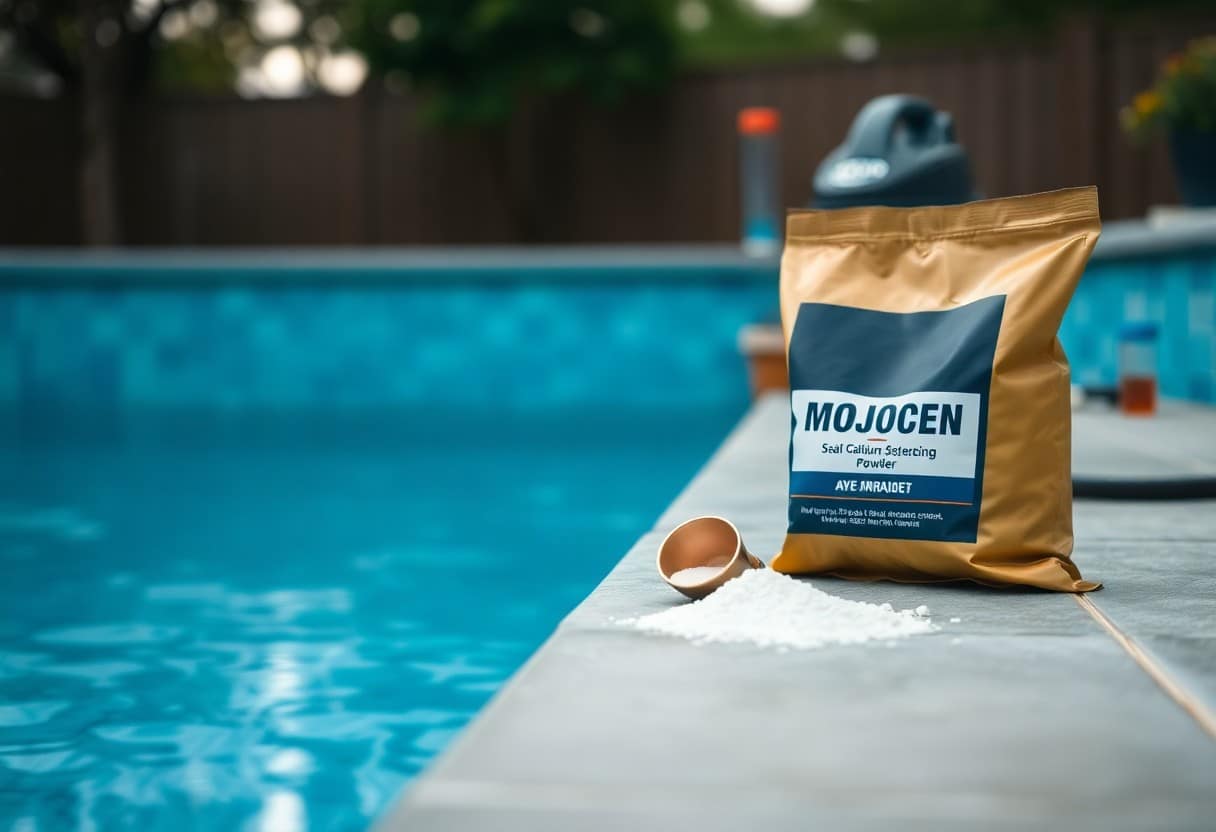
Sequestering agents containing phosphonates or polyphosphates bind calcium ions and can cut visible scaling by 50-80% when dosed per label; treat weekly after heavy fills. If you must raise calcium, use calcium chloride slowly and retest after 24 hours; rapid additions can spike saturation index and paradoxically trigger precipitation. Keep a treatment log so you can correlate chemistry changes with local well or city supply events.
Importance of Filtration
Run your pump long enough to achieve one full turnover every 8-12 hours; in hot McKinney summers aim for 10-12 hours. Backwash sand/DE filters or clean cartridges when pressure climbs 8-10 psi above the clean baseline, and clean cartridges monthly. Effective filtration removes fine particulates that act as nucleation sites for calcium carbonate, reducing deposit formation.
DE filters capture particles down to 2-5 microns, cartridge filters down to about 10-15 microns, and sand filters around 20-40 microns; selecting DE or cartridge is smarter when you have hard source water. Supplement with a clarifier or flocculant after heavy bather loads, and inspect skimmer baskets daily – trapped debris accelerates scale when it decays in warm water.

Treatment Options for Existing Deposits
Removing Surface Deposits
You can remove light scale with a non‑metallic brush, pumice stone or a Scotch‑Brite pad and a commercial tile/scale cleaner; for stubborn waterline rings, use a pressure washer at 800-1,200 psi on plaster or tile, and follow with a sequestrant (polyphosphate or EDTA product) to hold calcium in solution; perform spot tests on older finishes to avoid glazing or surface damage.
Acid Washing Techniques
You should reserve acid washing for heavy, bonded deposits that resist mechanical and chemical scrubbing because it strips about 1/32-1/16″ of plaster and shortens surface life; drain the pool, wear full PPE, apply diluted muriatic acid, then neutralize and rinse thoroughly before refilling and rebalancing water chemistry.
If you proceed, dilute acid following label guidance (common ranges 1:4 to 1:10 acid:water) and always add acid to water; test a small area for contact time to avoid over‑etching, neutralize spent acid with soda ash or baking soda, capture runoff per McKinney disposal rules, and plan for final pH 7.2-7.6 and calcium hardness 200-400 ppm after refill.
Professional Services
You can hire licensed pool contractors who offer scale removal, soda/sand blasting, or full replastering; typical cleaning/acid‑wash jobs run $300-$1,200 depending on pool size and severity, while replastering is commonly $4,000-$10,000; professionals bring specialized equipment that reduces plaster loss and can apply sealers or long‑term sequestrants for repeat prevention.
When you hire a professional, expect a written inspection, chemical analysis, and a recommended plan (soda blasting, micro‑abrasion, acid wash, or resurfacing); request proof of insurance, references, a 1-5 year workmanship warranty, and confirmation they follow local McKinney runoff/disposal rules and use PHTA‑trained technicians for best practices.
Preventative Measures
Installation of Water Softeners
You can install an ion-exchange water softener on your fill or whole-house line to swap Ca2+/Mg2+ for Na+, lowering incoming hardness from common North Texas levels (>200 ppm ≈12 gpg) to under 1 gpg (≈17 mg/L) when properly sized. Choose a 30,000-50,000 grain unit for typical households, program regeneration based on use, and service resin annually so your pool fill water no longer brings in the calcium that seeds scale.
Using Pool Covers
Putting a tight-fitting cover on your pool when it’s not in use cuts evaporation and mineral concentration-solar and solid covers can reduce evaporation by up to 70-90% and lower chemical consumption by 50-70%-so you’ll limit the cyclical concentration changes that drive calcium precipitation. Use the cover nightly and during storms to minimize both water loss and the need to add fresh, hard makeup water.
For day-to-day use choose a solar blanket to retain heat (raising surface temperature 4-10°F) and an automatic reel for quick handling; for long-term protection use a reinforced solid cover. Clean covers monthly, remove pooling water, and inspect seams; a damaged cover loses effectiveness and can let debris concentrate minerals along the waterline, increasing localized scaling risk.
Regular Brushing and Vacuuming
You should brush tile and the waterline 2-3 times per week and vacuum at least once weekly to disrupt early mineral deposits before they harden-use nylon brushes on vinyl and soft finishes, stiffer nylon or stainless on plaster and tile, and focus along returns, steps, and skimmers where circulation is lower. Consistent mechanical removal prevents thin films from becoming tenacious scale.
When you spot white crusts, spend extra time on that area with targeted brushing and a 30-60 minute vacuum session; many pool pros report visible scale incidence drops by more than half when owners follow this cadence. If deposits persist, isolate the area and treat with a sequestrant or consult a technician to avoid aggressive abrasion on delicate surfaces.
Common Mistakes That Lead to Deposits
Ignoring Water Testing
If you skip regular testing, pH, total alkalinity (TA), and calcium hardness can drift into scale-forming ranges without you noticing; aim to test at least weekly in spring/fall and 2-3 times per week in hot months. Keep pH 7.2-7.6, TA 80-120 ppm, and calcium hardness 200-400 ppm – exceedances (pH >7.8 or hardness >400 ppm) commonly trigger visible calcium precipitate on McKinney pools fed by hard local water.
Overlooking Regular Maintenance
When you delay filter cleaning, backwashing, or brushing, minerals concentrate on pool surfaces and equipment; backwash when filter pressure climbs 6-8 psi above baseline, clean cartridges every 3-6 months, and brush walls weekly to prevent thin films that become scale anchors.
You should run the pump 8-12 hours daily in summer to maintain circulation and reduce localized saturation points where deposits form. Vacuum at least weekly, inspect heater and skimmer housings monthly, and address flow drops of 20-25% promptly – a community pool case showed visible scaling after operators cut run time to 4 hours/day and skipped backwashing for six weeks.
Mismanagement of Chemicals
Incorrect dosing, adding incompatible products, or dumping concentrated chemicals into the skimmer accelerates deposit formation; always follow label dosages, pre-dissolve granules when required, and wait 4-6 hours between major adjustments so pH, TA, and hardness can stabilize before retesting.
Avoid routinely using calcium chloride to bump hardness without checking baseline levels – cumulative additions can push hardness past 400 ppm. Keep cyanuric acid in the 30-50 ppm range, because excessive CYA forces higher free chlorine and dosing that alters water balance. If you must make multiple corrections, sequence them: correct alkalinity first, then pH, then chlorine and hardness, testing between each step to prevent overshoot and scale formation.
Conclusion
So you can prevent calcium deposits in your McKinney pool by keeping water balanced-pH 7.2-7.6, total alkalinity 80-120 ppm and calcium hardness appropriate for your finish (200-400 ppm for plaster); use scale inhibitors or sequestering agents if local water is hard, lower the saturation index (LSI) with small acid additions, maintain filtration and circulation, brush surfaces regularly, and test water weekly to catch imbalances early.
FAQ
Q: What causes calcium deposits in a McKinney pool and how can I prevent them?
A: Calcium deposits form when water is oversaturated with calcium and carbonate, often driven by high calcium hardness, elevated pH, high total alkalinity, high temperature, or significant evaporation. Prevent deposits by keeping calcium hardness in the recommended range (typically 200-400 ppm for plaster, lower for vinyl), maintaining pH 7.2-7.6, total alkalinity 80-120 ppm, and controlling water temperature and evaporation. Use scale inhibitors or sequestrants when source water is hard and avoid adding unnecessary calcium-based chemicals.
Q: How often should I test pool chemistry to prevent scaling?
A: Test pH and free chlorine 2-3 times per week (daily under heavy use or heat), total alkalinity and calcium hardness weekly, and total dissolved solids and cyanuric acid monthly. Adjust chemistry quickly if pH drifts upward or hardness is rising. Log results to track trends and treat proactively with acid to lower pH/alkalinity or a sequestering agent to bind excess calcium.
Q: What filtration and circulation practices reduce calcium buildup?
A: Run the pump long enough to achieve full turnover (typically 8-12 hours daily; increase in hot weather). Keep filters clean and backwash/clean cartridges per manufacturer recommendations to remove precipitated minerals. Ensure good flow across heaters and solar panels, and avoid prolonged high heater temperatures. Consider installing an automatic chemical feeder or inline scale inhibitor for continuous protection when source water is hard.
Q: Which cleaning methods are effective for preventing and removing scale on tiles and plaster?
A: Brush tile, steps, and plaster weekly to keep mineral films from hardening. For fresh, light deposits use a commercial tile scale remover or a mild acid solution following label instructions. For heavier scale consult a pool professional for pumice, acid wash, or resurfacing options; aggressive scraping can damage plaster or tile grout. After treatment, rebalance water and use a sequestering agent to limit re-deposition.
Q: My fill water in McKinney is hard. What should I do when refilling or topping off to avoid deposits?
A: Test source water hardness before filling. If hardness is high, avoid large single fills; perform partial drains and refills over time or use softened or RO-treated water. Add a sequestrant at startup and periodically when filling with hard water. If continuous hard-source fills are unavoidable, schedule more frequent monitoring and use scale inhibitors or hire an RO fill service to keep calcium levels in the target range.