There’s a distinct chemical smell when combined chlorine (chloramines) builds up; you should test free and total chlorine, adjust pH, and shock the pool to remove chloramines, run filtration and backwash, and add oxidizers or use non-chlorine shock. Maintain proper sanitizer levels and circulation, clean filters, and consider a UV or ozone system if odors persist. If you’re unsure, call a licensed pool technician for targeted service.
Key Takeaways:
- Test and balance water: measure free chlorine, total chlorine (determine combined chlorine), pH (7.2-7.6), total alkalinity (80-120 ppm) and cyanuric acid (30-50 ppm for outdoor pools).
- Eliminate chloramines with breakpoint chlorination: shock the pool to raise free chlorine to about 10× the combined-chlorine level and maintain until combined chlorine drops below 0.2 ppm.
- Improve circulation and filtration: run the pump longer, backwash/clean or replace filters, brush and vacuum surfaces to remove organics that create chloramines.
- Reduce organic load: require pre-swim showers, manage bather load, use enzyme treatments and shock after heavy use or storms.
- If odor persists: consider partial drain/refill, check for excessively high cyanuric acid, or hire a local pool professional for advanced testing and treatment.
Understanding Chlorine Odors
What Causes Chlorine Odors?
You encounter strong chlorine odors when free chlorine reacts with nitrogen-containing contaminants like sweat, urine, and cosmetics to form chloramines; these combined chlorines (mono-, di-, and trichloramine) are volatile and produce the familiar sharp smell and eye irritation. You should watch combined chlorine levels-anything above about 0.2 ppm signals buildup-and address bather load, filtration, and oxidizer levels to reduce odors.
The Chemical Reaction of Chlorine in Pools
You create sanitizing hypochlorous acid (HOCl) and hypochlorite (OCl-) when you add chlorine; those species attack organics and nitrogen compounds, producing monochloramine (NH2Cl), dichloramine (NHCl2), and trichloramine (NCl3). Trichloramine is the most volatile and odorous, and the pH, temperature, and organic load shift the HOCl/OCl- balance and reaction rates.
When you dig deeper, the kinetics matter: higher water temperature and heavy swimmer load accelerate chloramine formation, while pH around 7.2-7.6 favors HOCl, the more effective sanitizer. To remove chloramines you use breakpoint chlorination-raising free chlorine to roughly ten times the combined chlorine level (for example, if combined chlorine is 1.0 ppm, raise free chlorine toward 10 ppm briefly) so nitrogen compounds are oxidized rather than merely chlorinated. You can verify this by measuring free and total chlorine (combined = total − free) and watching combined chlorine drop below 0.2 ppm; UV or ozone systems also break down chloramines without massive chlorine dosing.
Misconceptions About Chlorine Smell
You often assume a strong pool smell means too much chlorine, but it usually indicates too little free chlorine relative to contaminants-chloramines cause the odor. Over-chlorination can produce a bleachy smell, yet the pungent “pool smell” most commonly points to combined chlorine and inadequate oxidation or filtration, not excess sanitizer.
In practice, public pools with heavy bather loads can smell strongly even when free chlorine reads within 1-3 ppm because combined chlorine exceeds safe thresholds; testing will reveal the difference. You should know masking agents or perfumes only hide odors without addressing chloramines, and continual low-level chlorination won’t break the bond-breakpoint treatment, improved turnover, shock dosing, or secondary oxidation (UV/ozone) are the proven fixes to eliminate the source rather than cover it up.

Health Implications of Strong Chlorine Smells
Effects on Swimmers
You may experience stinging eyes, burning nasal passages, coughing and throat tightness when chloramine levels rise; free chlorine should be 1-3 ppm and combined chlorine above 0.5 ppm often produces the strong odor and irritation you notice. Children and people with asthma can develop wheezing within minutes, and frequent swimmers commonly report recurring eye and airway symptoms after regular pool sessions.
Allergic Reactions and Sensitivities
You can develop contact dermatitis, hives or allergic conjunctivitis from pool chemical exposures; those with eczema or preexisting chemical sensitivities are at higher risk. Mild reactions typically improve after rinsing and changing out of swimwear, while persistent rashes or breathing difficulty warrant medical evaluation and possible antihistamines or topical treatments prescribed by your clinician.
Distinguish irritant responses from true allergic reactions: irritant symptoms show up rapidly and often resolve after leaving the pool, whereas allergic contact dermatitis usually appears 24-72 hours later and can persist without treatment. If you get recurrent or delayed rashes, ask a dermatologist about patch testing for pool chemical additives and avoid further exposure until you have a diagnosis.
Long-term Health Risks
With repeated, long-term exposure you face increased chance of chronic airway inflammation and persistent respiratory symptoms; epidemiological data link frequent use of poorly ventilated indoor chlorinated pools to higher rates of asthma and reduced lung function among competitive swimmers and pool workers.
Mechanistically, chloramines and oxidants damage airway epithelium, promoting inflammation and hyperresponsiveness. To reduce long-term risk, keep free chlorine at 1-3 ppm and combined chlorine under 0.5 ppm, improve pool ventilation, consider UV or ozone secondary disinfection to destroy chloramines, and limit cumulative exposure for children and competitive athletes-measures that facilities often adopt to lower respiratory complaints.
Assessing Pool Water Quality
Importance of pH Balance
You should keep your pool pH between 7.2 and 7.8, with 7.4-7.6 ideal for chlorine efficiency and swimmer comfort. When pH climbs above 7.8 the proportion of hypochlorous acid drops, reducing disinfecting power and allowing chloramines to form, which produce strong odors; pH below 7.2 increases eye and skin irritation and risks corrosion of metal fittings.
Chlorine Levels and Their Effects
Target free chlorine (FC) of 1-3 ppm for residential pools; combined chlorine (CC) should be under 0.2 ppm. A strong chlorine smell usually signals elevated CC (chloramines), not high FC, so you’ll need to oxidize or shock the pool when CC exceeds the 0.2 ppm threshold.
Measure CC by subtracting FC from total chlorine (TC−FC). To perform breakpoint chlorination, add chlorine equal to roughly 10× the CC level-if CC is 0.8 ppm, add about 8 ppm of chlorine-and run circulation for 8-12 hours. Keep in mind cyanuric acid (CYA) binds free chlorine; with CYA at 30-50 ppm maintain FC near 2-4 ppm, but higher CYA requires proportionally higher FC. Non‑chlorine oxidizers (potassium monopersulfate) help remove organics but will not fully eliminate chloramines, so use a chlorine shock (liquid bleach or calcium hypochlorite) for chloramine problems.
Regular Water Testing
Test your pool at least weekly for pH, FC, TC, total alkalinity (80-120 ppm), and CYA (30-50 ppm); increase testing to daily during heat waves, heavy bather loads, or after storms. Keep a short log of date, time, and values so you can spot trends that correlate with odors or cloudiness.
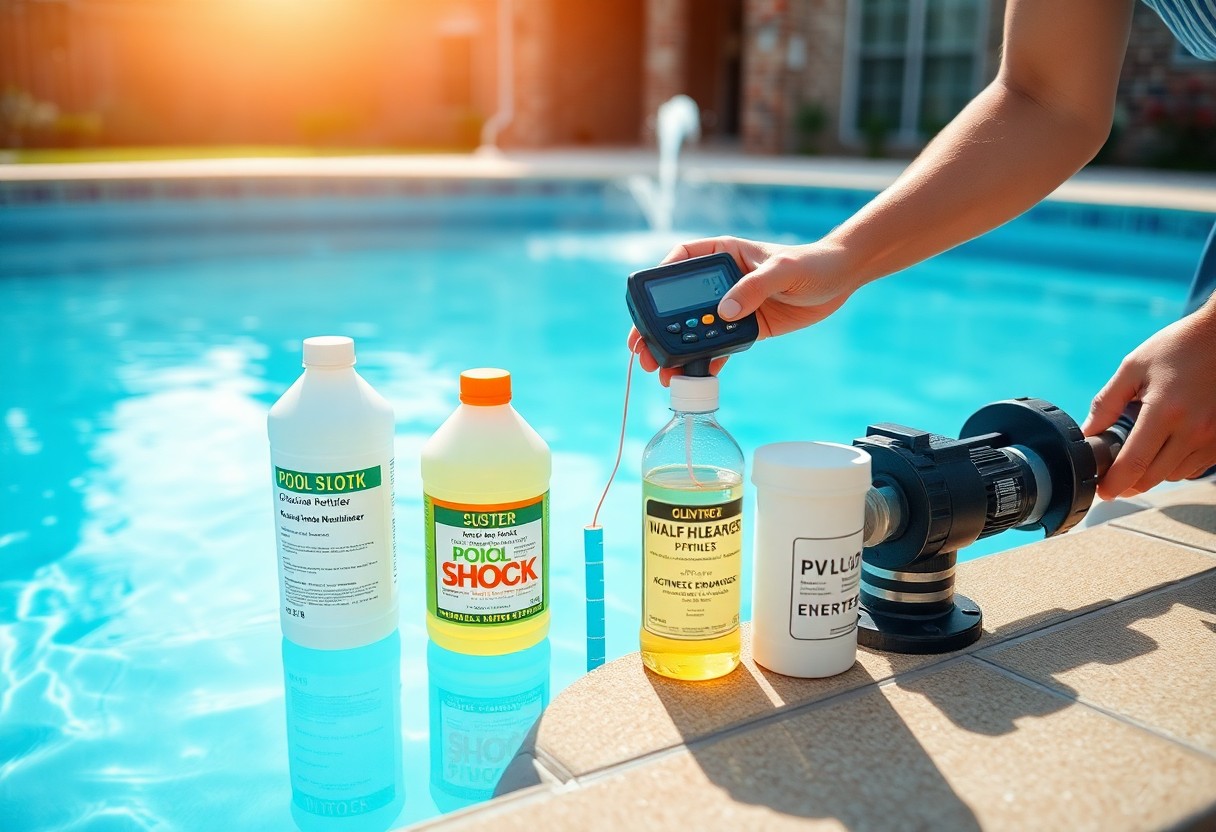
Use a DPD liquid test kit for the most reliable FC and TC readings; test strips are fine for quick checks but are less precise, while a digital photometer gives lab‑grade accuracy. Collect samples from elbow‑depth away from returns and test at the same time of day when possible. If values bounce or you detect persistent chloramines, bring a sample to a local McKinney pool store for a professional analysis of CYA, metals, and organic loadments that handheld kits can miss.
Preventive Measures to Reduce Chlorine Odors
Proper Pool Maintenance Practices
Test your water at least 3 times a week, keeping free chlorine around 1-3 ppm and combined chlorine below 0.2 ppm; maintain pH 7.2-7.6 and cyanuric acid 30-50 ppm, run the pump 8-12 hours daily, clean skimmer baskets and prefilters frequently, and backwash or clean cartridges when filter pressure rises 8-10 psi over baseline to prevent organics buildup that drives chloramine formation.
Regularly Shocking the Pool
Shock after heavy bather load, rain, or when combined chlorine exceeds 0.2 ppm; perform breakpoint chlorination by raising free chlorine to roughly 10× the combined chlorine level, then circulate and test until free chlorine returns to your normal operating range before allowing swimmers back.
Use non-stabilized oxidizers (calcium hypochlorite or chlorine-free oxidizers) at dusk to avoid UV loss, run filtration 12-24 hours post-shock, and brush surfaces to release trapped organics. If combined chlorine is 0.5 ppm, for example, target a free chlorine spike near 5 ppm for breakpoint; retest hourly until combined chlorine falls and pH stabilizes. Avoid mixing products and follow manufacturer dosing for your pool volume.
Using Alternative Sanitizers
Consider a salt chlorine generator, UV or ozone feeder, or mineral system to lower chloramine production: salt generators still produce chlorine but smooth residuals, while UV/ozone oxidize chloramines in-line, reducing the distinctive odor and cutting chlorine demand when paired with lower residual setpoints.
UV systems typically oxidize a large proportion of combined chlorine in the treated flow, often reducing chloramine concentrations by a substantial margin and allowing many facilities to run lower free chlorine setpoints safely. Ozone acts as a strong oxidizer that can reduce chlorine demand by roughly 30-50% when sized correctly. Mineral or ionizer systems reduce organic load and bacterial counts so you can maintain lower chlorine; biguanide systems require a chlorine-free schedule and cannot be mixed with chlorine, so consult local code and a qualified technician before converting.
Methods to Eliminate Existing Chlorine Odors
Aeration Techniques
By increasing surface agitation you strip volatile mono-chloramine gas that causes the smell; aim return jets at the surface, run a fountain or waterfall, or install an air injector. Run aeration for 4-8 hours after shocking or until combined chlorine drops below 0.2 ppm, and repeat daily if needed. Use a DPD test kit to track combined chlorine and pair aeration with a heavy turnover (one to two full turnovers) to speed removal.
Adding Natural Enzymes
Many enzyme products contain protease, lipase and amylase to break down nitrogenous organics that consume free chlorine and form chloramines; common dosing is 1-2 fl oz per 10,000 gallons weekly. You’ll see reduced chlorine demand and fewer odors over 1-2 weeks when enzymes are used as maintenance alongside proper filtration and occasional shock.
Enzymes don’t instantly remove existing chloramines, but they lower the organic load so future chloramine re-formation is reduced. For a 20,000-gallon pool you might dose 2-4 fl oz weekly and continue routine shocking (raise free chlorine to about 10× the combined chlorine for breakpoint if levels are high) and aerate after treatment; test free and combined chlorine weekly and follow the manufacturer’s label for best results.
Utilizing Pool Covers
Using a cover when the pool is idle reduces leaves, cosmetics and sunlight exposure that drive chloramine formation, which can cut chemical usage and debris by roughly 30-50% and drastically reduce evaporation. You should cover nights and long idle periods to limit fresh organic input that fuels the odor problem.
Choose the right cover type-solar covers are simple and lower chemical loss, while solid covers block nearly all debris. After you shock and aerate, remove the cover to vent trapped gases for several hours rather than uncovering and immediately swimming; for ongoing control, make covering part of your weekly routine and continue testing so you can adjust dosing and aeration as needed.
Enhancing Air Quality around the Pool
Improving Ventilation
You should target 4-8 air changes per hour (ACH) in pool enclosures and keep relative humidity near 50-60% to limit chloramine accumulation; for example, a 2,000 ft² room with a 12 ft ceiling (24,000 ft³) needs about 2,400 CFM for 6 ACH (Volume×ACH/60). Place low-velocity supply diffusers near the deck and high-level returns to sweep chloramine-laden air upward, and balance make-up air with an ERV/HRV to avoid negative pressure that pulls odors into adjoining spaces.
Indoor Pool Solutions
You should install a dedicated pool-room HVAC and dehumidifier sized for the room and bather load-residential systems often run 50-200 pints/day, while commercial units are sized higher-paired with an ERV for fresh air. Add in-line UV or advanced oxidation for water treatment to cut combined chlorine, and maintain coil and filter cleaning on a 3-6 month schedule to keep airflow and odor control effective.
For placement and equipment specifics, you should locate supply diffusers low and close to the deck (within 3-6 ft) and returns at ceiling level or dedicated exhaust points near clerestory vents so chloramines are removed before they mix with breathing zones. Consider UV reactors rated to treat full turnover times-many systems reduce combined chlorine 60-80%-and choose commercial dehumidifiers sized via heat-plus-evaporation load calculations rather than room area alone.
Outdoor Pool Considerations
You can rely on open-air dilution to disperse most chloramine odors, but you should still position chemical feeders, skimmers and HVAC intakes at least 10-20 ft from seating and picnic areas and orient seating upwind of those sources. Use covers when the pool is idle to limit off-gassing, and employ low hedges or permeable windbreaks to control where odors travel without trapping air over the water.
When siting amenities, you should map prevailing wind directions onsite and run a quick smoke or incense test on a calm day to see odor paths; small design changes-moving a mechanical room 15 ft or angling seating 30-45°-often cut guest complaints. Also, choose permeable landscaping (shrubs 3-5 ft high) to redirect breezes rather than block ventilation, and schedule major chemical additions downwind or during low-use hours to minimize exposure.
The Role of Professional Help
When to Call a Pool Technician
If the chlorine smell persists after proper shocking, combined chlorine measures above 0.5 ppm, or you have chronic eye/skin irritation, call a technician; they can run a DPD test, measure combined vs. free chlorine, and perform breakpoint chlorination (raising free chlorine roughly 10× the combined chlorine) safely. For repeated cloudiness, pH swings, or equipment faults-broken pump seals, clogged DE grids-you want a pro who can diagnose whether the issue is chloramines, filtration failure, or ozone/UV inefficiency.
Hiring a Pool Service
Vet providers by checking Certified Pool Operator (CPO) credentials, liability insurance, local references, and written service scopes; ask for sample logs showing tests and chemical dosages, average response time for emergencies, and whether they offer oxidation treatments or UV/ozone installation. You should get at least three quotes and compare what’s included-weekly maintenance, one-time shock, and diagnostic fees-before you sign.
Expect service agreements that define visit frequency, included chemicals, and equipment checks: weekly visits typically cover skimming, vacuuming, chemical adjustment, and filter backwash; a specialized visit might cost $75-$150, while comprehensive monthly plans run $100-$300 depending on pool size and equipment. Technicians often document readings (free chlorine, combined chlorine, pH, TA, stabilizer), recommend breakpoint chlorination when combined chlorine >0.5 ppm, and can install UV/ozone systems ($1,200-$4,000) or replace pumps/filters ($400-$2,000).
Cost Factors and Services Offered
Costs depend on pool size, frequency of visits, chemical usage, and necessary repairs; typical one-time shock treatment runs $50-$150, a weekly maintenance visit $75-$150, and an acid wash $300-$1,000. Any contract you sign should list included tests, turnaround times for repairs, and cancellation terms.
- Weekly maintenance: skimming, testing, chemical adjustment
- One-off services: shock/oxidation, enzyme treatment, filter clean
- Equipment work: pump/motor replacement, cartridge/DE servicing
- Any contractor should provide a written estimate and itemized invoice
More detailed pricing often reflects water chemistry complexity and required technology: breakpoint chlorination to remove chloramines may require raising free chlorine to 10× combined chlorine (technician-administered shock), which can cost $75-$200 per treatment; installing UV or advanced oxidation for long-term chloramine control typically ranges $1,200-$4,000 but can cut chemical use and odor complaints. Any reputable service will supply pre- and post-treatment test results and a follow-up plan to prevent recurrence.
- Shock/breakpoint treatment: $75-$200 per event
- Monthly maintenance plans: $100-$300
- UV/ozone installation: $1,200-$4,000
- Any service should include documented water readings before and after treatment
Summing up
Presently you should test your pool water for free and combined chlorine, pH and cyanuric acid; then raise free chlorine with breakpoint chlorination (shock) to destroy chloramines, running the filter continuously and backwashing as needed. Drain and refill partly if combined chlorine remains high, and maintain free chlorine 1-3 ppm and combined chlorine <0.2 ppm. If odor persists in your McKinney pool, hire a professional for a detailed inspection.
FAQ
Q: Why does my McKinney pool smell strongly of chlorine even though I recently added chlorine?
A: A strong chlorine smell usually means chloramines (combined chlorine), not excess free chlorine. Organic contaminants (sweat, lotion, urine), poor circulation, or high cyanuric acid can bind free chlorine into chloramines, which cause the odor and reduced sanitizer effectiveness. Test free chlorine (FC) and total chlorine (TC); combined chlorine (CC) = TC − FC. If CC is above ~0.2 ppm, chloramines are present.
Q: What immediate steps remove the strong chlorine odor?
A: Test FC, CC, pH and CYA. Perform breakpoint chlorination: raise free chlorine to about 10× the combined chlorine level (for example, if CC = 0.5 ppm, raise FC to ~5 ppm above current level) using pool shock (calcium hypochlorite or liquid bleach), keep pump and filter running, maintain pH 7.2-7.6, and circulate for 8-24 hours. Retest and repeat if CC remains high. Do not swim until FC is back to safe range (typically 1-4 ppm) and CC is below ~0.2 ppm.
Q: Which maintenance practices prevent recurrence of strong chlorine odors?
A: Maintain regular testing and balancing: keep FC in recommended range and CYA around 30-50 ppm for outdoor pools. Shock after heavy use, storms, or algae. Clean or backwash filters and maintain good circulation (run pump adequate hours daily). Encourage swimmers to shower before entering, limit organic loads, and use enzyme clarifiers to reduce body oils and organic waste.
Q: Could McKinney municipal water cause the odor when filling or topping off my pool, and what should I do?
A: Some municipal systems add chloramines to tap water; filling with chloraminated water can introduce odor-causing compounds. After filling, perform breakpoint chlorination to oxidize combined chlorines, or ask the water utility about chloramine levels and treatment options. Continuous treatment (proper chlorine dosing, good circulation, or supplemental UV/ozone) is more effective than attempting to pre-dechlorinate fill water.
Q: When should I call a professional or consider draining the pool?
A: Call a certified pool professional if chloramine odor persists after breakpoint treatment, if CYA is very high (often >100 ppm), if filters appear ineffective or damaged, or if you’re unsure how to dose chemicals safely. Partial or full drain-and-refill is an option when CYA is excessively high or contamination is persistent, but check local discharge rules and get professional guidance to avoid chemical or structural mistakes.