With a consistent weekly schedule and adjustments for Frisco’s heat and water hardness, you can keep your pool clean, safe, and inviting year-round. You should test and balance chemicals, clean filters and skimmers, brush walls, vacuum debris, and inspect equipment; shock after heavy use or storms, and schedule a professional service seasonally for repairs and detailed inspections.
Key Takeaways:
- Regular testing and chemical balance: test 2-3×/week in summer (weekly off-season); free chlorine 1-3 ppm, pH 7.2-7.6, total alkalinity 80-120 ppm, cyanuric acid 30-50 ppm, calcium hardness 200-400 ppm.
- Maintain filtration and circulation: run pump 8-12 hours/day in summer (6-8 hours cooler months); backwash when filter pressure rises 8-10 psi over clean; clean skimmer and pump baskets weekly and cartridge filters monthly.
- Shock and clean weekly: shock after heavy use, storms, or sustained heat; brush walls and vacuum weekly; use algaecide preventatively during warm months.
- Protect for Frisco weather: winterize if several consecutive nights below 32°F-blow and plug lines, lower water where required, and insulate or remove sensitive equipment; use a cover and freeze-protection if keeping the pool open year‑round.
- Professional service and safety: schedule seasonal or monthly tune-ups for heaters, pumps, and salt cells; maintain fencing, alarms, and rescue equipment.
Understanding Pool Maintenance
Importance of Regular Pool Care
Testing your water at least twice weekly keeps contaminants in check; aim for free chlorine 1-3 ppm, pH 7.4-7.6, total alkalinity 80-120 ppm and calcium hardness 200-400 ppm. Running your pump 8-12 hours daily during peak season, cleaning skimmer baskets every few days, and backwashing or cleaning filters when pressure rises 8-10 psi above baseline prevents algae, extends equipment life, and often saves you hundreds in repairs annually.
Common Pool Issues in Frisco
Frisco’s long, hot summers (daily highs often above 95°F June-August), heavy spring pollen, and occasional storm runoff drive frequent algae blooms, high chlorine demand, cloudy water, mineral scaling from moderately hard tap water, and clogged filters; you’ll notice these as green tinting, sharp chlorine smell, or a steady rise in filter pressure.
When temperatures exceed 80°F and free chlorine falls below 1 ppm, green algae can appear within 48-72 hours, so you should shock to 8-10 ppm for a quick kill or use a copper-based algaecide for recurring outbreaks. Backwash sand or DE filters weekly in high-use periods, clean cartridge filters every 2-4 weeks, and if you run a salt system keep salt near the manufacturer’s 2,700-3,400 ppm range to maintain consistent output.
Weekly Maintenance Routine
Skimming and Debris Removal
You should skim the surface and empty skimmer baskets 5-10 minutes every day or at least every other day; Frisco’s oak and cedar pollen plus summer storms can dump leaves fast. Use a fine-mesh leaf skimmer on a telescopic pole to catch insects and small debris before they sink, and inspect the main drain and skimmer baskets – if they’re more than half full, clear them to keep flow steady and reduce filter load.
Brushing Pool Walls and Tiles
Brush walls, steps, and the waterline once a week for 5-15 minutes depending on pool size, focusing on corners, grout lines, and areas with visible film or algae. Select the right brush for your finish so you don’t abrade the surface: softer for vinyl or fiberglass, firmer for concrete and tile, and concentrate on the waterline where oils and scum collect.
Choose brush type by surface: nylon brushes work best for vinyl and fiberglass, while stainless-steel or stiff nylon brushes suit plaster and concrete; for ceramic tile use a grout brush or nonabrasive pad to remove calcium deposits. Brush in overlapping strokes and pay extra attention to steps, ladders, and return jets; after brushing, run the pump 8-12 hours to filter dislodged particles.
Vacuuming the Pool
Vacuum manually or run your robotic/automatic vacuum weekly-allocate 20-30 minutes for manual vacuuming on medium suction and slow, overlapping passes. Concentrate on the deep end, corners, and step edges where debris collects, and vacuum after brushing so you pick up loosened algae and dirt rather than letting it resettle.
For manual vacuuming, start with a clean filter and properly primed hose, bleed air from the head, and use a slow S-pattern to avoid stirring sediment. If you encounter heavy debris, set the multiport valve to “waste” to prevent clogging the filter; when finished, backwash or clean the filter and check pressure before resuming normal circulation.
Cleaning Pool Filters
Check your filter pressure gauge weekly and clean skimmer and pump baskets every time you skim. Backwash sand or DE filters when pressure rises 8-10 psi above the clean baseline; for cartridge filters, hose off cartridges every 4-6 weeks and perform a deep chemical soak every 3-6 months depending on use and local debris load.
For sand filters, backwash until sight glass runs clear and then rinse for 1-2 minutes; replace sand every 4-7 years. With DE filters, backwash and add the manufacturer’s recommended DE amount after each service. For cartridges, remove, hose each pleat from top to bottom, and soak in a filter cleaner if oils or scale persist; always record baseline pressures so you know when service is needed.

Water Chemistry Management
Testing Pool Water
You should test your pool at least 2-3 times per week in summer and after heavy use or storms, using a reliable kit like Taylor or a digital tester; measure free and total chlorine, pH, total alkalinity, calcium hardness and cyanuric acid, sampling 12-18 inches below the surface and away from returns to get accurate readings.
Balancing pH Levels
Maintain pH between 7.2 and 7.6 for optimal comfort and sanitizer efficiency; lower pH with muriatic acid or sodium bisulfate and raise it with soda ash, adding chemicals in small increments and retesting after 4-6 hours to avoid overshoot.
When your pH drifts above 7.6 you’ll notice cloudy water and reduced chlorine activity, while pH below 7.2 causes eye and skin irritation and accelerates metal corrosion; because total alkalinity buffers pH, adjust alkalinity first when it’s outside 80-120 ppm, then make pH tweaks, and consider an automatic acid feeder or pH controller if you manage a large Frisco pool where heat and sunscreen frequently shift pH.
Chlorine and Sanitizer Levels
Keep free chlorine around 1.0-3.0 ppm for routine use and consider 2-4 ppm during Frisco’s hot months or high bather load; test daily, use stabilized tablets, liquid bleach, or a salt chlorine generator, and monitor combined chlorine (should be <0.2 ppm) to spot chloramine buildup.
When combined chlorine exceeds 0.2 ppm you need to shock to breakpoint to oxidize contaminants-do this weekly, after parties, or post-storm; aim to temporarily raise free chlorine well above normal (follow the product label or a pro) and let the pump run for several hours, and for salt systems clean the cell every 1-3 months to maintain output and consistent sanitizer levels.
Alkalinity and Calcium Hardness
Target total alkalinity of 80-120 ppm to stabilize pH and calcium hardness of 200-400 ppm (plaster pools on the higher end); raise alkalinity with sodium bicarbonate and lower it slowly with acid, while increasing hardness with calcium chloride if levels are low.
Since alkalinity acts as your pool’s buffer, low values cause pH to swing wildly and high values make pH hard to change-so always correct alkalinity before pH; for calcium hardness, low levels can etch plaster and corrode metal, while high levels (above ~400 ppm) create scale-if your Frisco source water is moderately hard, you may need partial drains, sequestering agents, or controlled additions of calcium chloride per the manufacturer’s dosing chart to bring levels into the 200-400 ppm range.
Seasonal Pool Care
Preparing for Summer: Opening Your Pool
You should test and balance your water to pH 7.2-7.6, total alkalinity 80-120 ppm and calcium hardness 200-400 ppm before heavy use, then shock with about 1 lb of granular chlorine per 10,000 gallons if combined chlorine is high. Run the pump 24 hours on opening day, backwash if filter pressure rises 8-10 psi above baseline, clean skimmer and pump baskets, and add a preventative algaecide dose to avoid early blooms.
Winterizing Your Pool
When temperatures drop, lower your water level 4-6 inches below the skimmer (or per manufacturer), balance pH to 7.2-7.6 and shock the pool at 1 lb per 10,000 gallons, then add a long‑lasting algaecide and a stabilizer dose if needed. Fit winterizing plugs in returns, install an air pillow for vinyl liners, and cover the pool with a durable cover to keep debris and sunlight out.
For plumbing, either use a professional-grade line blowout or a wet/dry vacuum to evacuate water from returns and skimmers, then insert winter plugs; avoid leaving water in the pump, heater and filter-drain them to the lowest service port and store removable equipment indoors. If you have a salt cell, clean scaling and expect a 3-5 year service life; schedule a service call if you’re unsure about pressure-tested line blowouts or heater shutdown procedures.
Seasonal Equipment Checks
Schedule a thorough equipment inspection each season: note baseline filter pressure (typically 10-15 psi), backwash or clean when pressure increases by 8-10 psi, inspect pump seal and O‑ring for leaks, test heater ignition and freeze protection, and replace worn belts or corroded fittings before peak use. Log run hours and check automation timers and sensors for proper operation.
More deeply, remove and service cartridge or DE elements per manufacturer intervals, check skimmer weir movement and clean hair and lint strainers, and test flow rates-measure gallons per minute at the return if possible to verify pump and filter performance. For automation, update firmware and validate temperature and chemical probe readings against handheld test kits; addressing a 10-20% drop in flow or persistent pressure spikes early prevents costly repairs mid‑season.
Addressing Pool Equipment and Systems
Understanding Pool Filtration Systems
You should size your filtration to achieve one turnover every 8-12 hours; for a 20,000‑gallon pool that’s roughly 30-50 GPM. Watch the filter pressure gauge and backwash when it rises 8-10 psi above the clean baseline. Sand filters often need weekly backwashing under heavy use, cartridges require rinsing every 1-3 months, and DE filters need recharging after backwash-log gauge trends to spot declining performance.
Maintaining Pool Pumps
Run your pump 8-12 hours daily during peak season and inspect the strainer basket weekly-clearing leaves and hair prevents cavitation and flow loss. Listen for grinding or rattling, check for leaks around seals, and compare motor amp draw to the nameplate; a 10-20% sustained increase signals trouble. Program variable‑speed pumps for low continuous circulation and occasional high‑speed cleaning cycles to cut energy use.
When servicing the pump, shut power, remove the lid, and inspect the basket and impeller for obstructions; clean and lubricate O‑rings with silicone grease and replace cracked seals. Use a clamp meter to measure amps during operation and a flowmeter or pressure readings to confirm target GPM-about 33 GPM for a 20,000‑gal pool with a 10‑hour turnover. Replace the mechanical shaft seal every 3-5 years or if you see leakage, and call a technician if you detect vibration, overheating, or a 10%+ amp spike.
Inspecting Heaters and Cleaners
Gas heaters need annual burner and heat‑exchanger cleaning, vent checks, and ignition testing; watch flame color for soot buildup and keep a CO detector nearby. Heat pumps require 12-24 inches of clearance and quarterly coil cleaning to retain efficiency. For cleaners, empty debris bags after each run, inspect hoses and wheels for damage, and replace worn treads to prevent jamming and poor coverage.
Verify adequate water flow before firing heaters-insufficient flow can warp heat exchangers-and record temperature rise (many gas heaters add 20-40°F per pass depending on BTU rating). For cleaners, remove and inspect impellers on suction models, replace belts on pressure units, and deep‑clean robotic filters monthly; technicians often find neglected impellers and clogged hoses cut cleaner efficiency by over half after a single season of heavy debris.
Pest and Algae Control
Common Algae Types in Frisco Pools
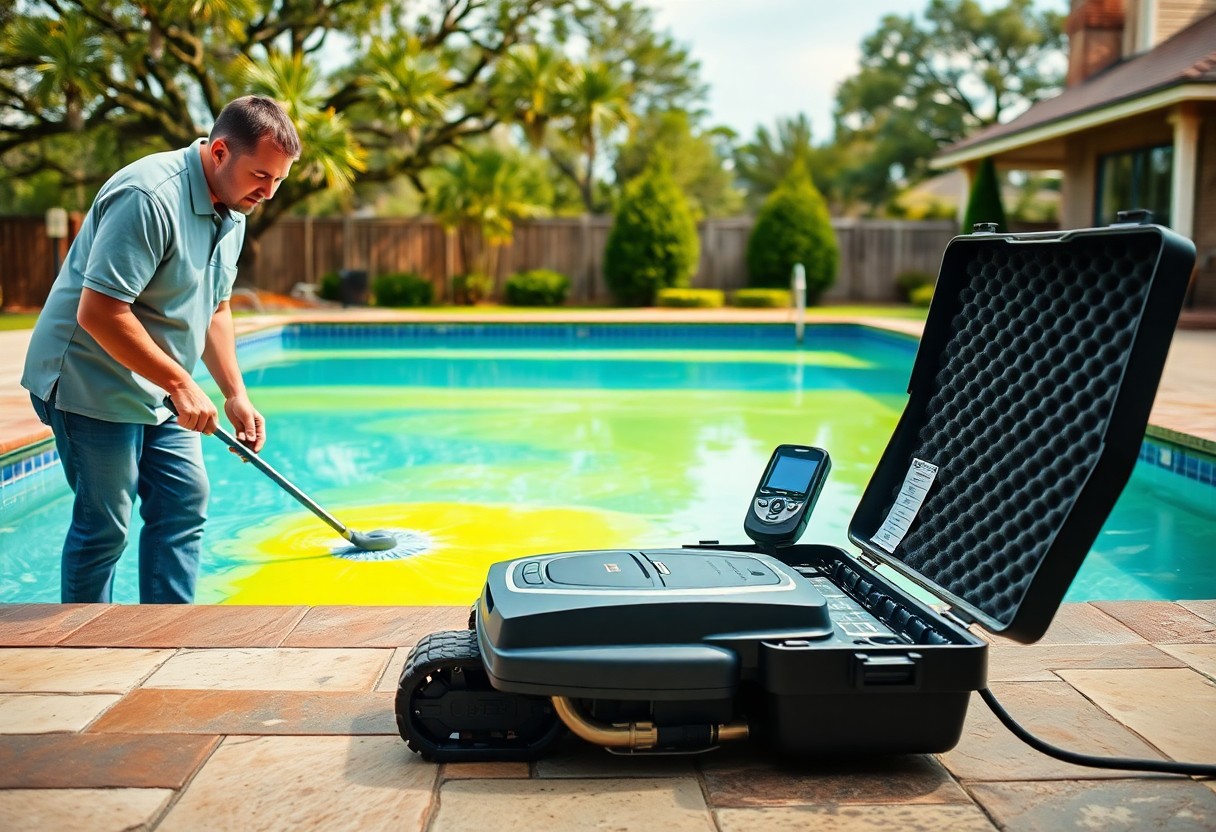
You frequently encounter green algae (fast-spreading), mustard/yellow (stubborn on plaster), black (deep-rooted in grout and returns if not scrubbed), filamentous/string algae (tangles that clog filters), and pink biofilm (bacterial slime on steps). Green can bloom within 24-48 hours if free chlorine drops below ~1 ppm; black often needs repeated 10-20 ppm shock plus aggressive brushing. Perceiving an early patch lets you treat locally before it colonizes the entire surface.
- Green: quick to show after low chlorine; treat with shock and brush.
- Mustard: clings to rough surfaces; use algaecide and vacuuming.
- Black: anchors in crevices; requires wire brush and high-dose shock.
- Filamentous: removes mechanically then treat with long-lasting algicide.
- Pink biofilm: clean with PHS or enzymatic cleaners and maintain sanitizer.
| Green algae | Appears cloudy/green within 24-48 hrs at <1 ppm free chlorine; shock to 10 ppm and brush; run filter 24-48 hrs. |
| Mustard (yellow) | Forms grainy deposits on plaster; treat with polyquat algaecide + vacuum; may need repeat dosing over 3-7 days. |
| Black algae | Dark spots in grout/rough areas; scrub to break roots, shock to 20 ppm if persistent, and use copper-free algaecide for follow-up. |
| Filamentous (string) | Long strands that tangle in skimmers; cut out, backwash filters, then dose with long-residual algaecide. |
| Pink biofilm | Bacterial slime on steps and drains; clean with enzymatic cleaners or PHS, then maintain 1-3 ppm free chlorine and good circulation. |
Preventive Measures Against Pests
You should eliminate standing water within a 50-100 ft radius, run the pool pump 8-12 hours daily during summer, and keep skimmer baskets and lights clean to reduce insects and frogs. Maintaining free chlorine at 1-3 ppm and pH at 7.2-7.6 cuts mosquito and bacterial attraction; trimming landscaping to reduce hiding spots also lowers wasp and rodent visits.
You can deploy Bti larvicide granules in nearby gutters and ornamental containers-Aedes mosquitoes can hatch in 24-48 hours-so check weekly after rain. Installing a tight-fitting solar cover reduces insects landing on the surface by up to 80% and cuts evaporation; pair that with LED dusk-to-dawn yard lighting to keep flying pests away from the pool area, and schedule quarterly inspections with your pest pro if you notice recurring infestations.
Effective Algae Treatment Solutions
You get the fastest results by testing and adjusting pH to 7.2-7.4, brushing affected areas, then shocking: raise free chlorine to ~10 ppm for green algae and consider 15-20 ppm for black algae outbreaks. Use a copper- or polyquat-based algaecide per label for follow-up, and run the filter continuously for 24-72 hours while vacuuming and backwashing as needed.
You should follow a stepwise protocol: measure TA and pH, correct pH first, brush all surfaces to dislodge spores, then apply granular or liquid shock (example: bring FC to 10 ppm for routine green blooms; for resistant black algae, repeat shocks every 24 hours while scrubbing). After visible clearance, dose a weekly preventative algaecide for 2-4 weeks and monitor with weekly tests; if recurrence happens within 30 days, consider professional-level oxidizers or clarifiers and inspect cartridge/DE elements for trapped spores.

Hiring Professional Pool Services
When to Consider Professional Help
When equipment fails, algae persists after 48 hours of treatment, or you’re facing seasonal opening/closing, call a pro; Frisco companies often respond within 24-48 hours and handle pump repairs, heater diagnostics, and acid washes safely. If your pool exceeds 20,000 gallons or you see green stains on plaster, professional intervention can prevent larger, costlier problems.
Choosing the Right Pool Care Service
You should vet licenses, insurance, and references; prefer companies with 3+ years in Frisco, technicians holding Certified Pool Operator (CPO) credentials, and transparent, itemized quotes with service guarantees. Check local reviews for consistent 4+ star ratings and jobs on pools like yours-fiberglass, vinyl, or concrete-to confirm relevant experience.
Ask providers how they document water chemistry: request sample logs showing monthly free chlorine, pH, alkalinity and cyanuric acid (targets: free chlorine 1-3 ppm, pH 7.2-7.8, TA 80-120 ppm). Also confirm emergency response time, parts warranties, whether they use digital titration versus strips, and whether seasonal plans include weekly visits, equipment inspection, and written reports-these details separate reactive shops from preventive teams.
Cost Effectiveness of Professional Services
Typical maintenance plans in Frisco run $75-$200 per month; while that adds up, you avoid repair costs like $400-$1,200 for a pump or $5,000-$10,000 for replastering. If you value time savings and stable water quality, a routine plan often pays for itself by catching issues early and reducing chemical waste.
Run a simple comparison: $120/month equals $1,440/year versus DIY chemical costs of $300-$600 plus the risk of a $900 heater or $2,000-$3,000 equipment repair from improper maintenance. One Frisco homeowner cut potential replaster costs by $2,800 after technicians corrected high cyanuric acid early-showing scheduled service can lower total annual ownership costs by roughly 20-40% depending on pool age and size.
Final Words
To wrap up, the best routine for Frisco homeowners is to test and balance your water 2-3 times weekly, run your pump 8-12 hours daily, clean skimmers and filters, brush and vacuum weekly, shock after heavy use or storms, and keep sanitizer and pH (7.2-7.6) within range; you should also perform seasonal equipment checks and manage stabilizer to prevent algae and protect your pool investment.
FAQ
Q: What is the best weekly pool care routine for Frisco homeowners?
A: Perform a daily quick check for debris and water level, and run your pump long enough for at least one full turnover (typically 8-12 hours in summer). Weekly tasks: skim and empty skimmer baskets, brush walls and steps, vacuum or run an automatic cleaner, test and adjust chemicals, and inspect the pump and filter for unusual noises or pressure changes. Shock the pool weekly or after heavy use, and add algaecide preventively during the warm months. Clean or backwash the filter as needed and spot-check tiles and equipment for wear.
Q: How often should I test water and what chemical levels should I maintain?
A: Test free chlorine, pH, total alkalinity, cyanuric acid, and calcium hardness at least twice weekly during warm months and weekly during cooler periods. Target ranges: free chlorine 1.0-3.0 ppm, pH 7.2-7.6, total alkalinity 80-120 ppm, calcium hardness 200-400 ppm (adjust by pool surface), and cyanuric acid 30-50 ppm for outdoor pools. Increase testing after heavy rain, heat waves, or heavy swimmer load; shock after storms or if chlorine demand spikes. Adjust chemicals gradually and retest after a few hours to confirm balance.
Q: How should I maintain my pump, filter, heater, and other equipment?
A: Check skimmer and pump baskets daily or every few days and clear debris to keep flow steady. For sand/DE filters, backwash when pressure rises 8-10 psi above baseline; for cartridges, clean monthly and replace as manufacturer recommends. Inspect pump seals, hoses, and O-rings monthly; lubricate O-rings with a pool-safe lubricant as needed. Clean salt-cell or chlorinator cells every 3-6 months for salt systems. Schedule a professional equipment inspection annually to check bearings, seals, and electrical connections.
Q: What should I do after heavy rains, heat waves, or freezing temperatures in Frisco?
A: After heavy rain: test and rebalance water, clean filters and skimmers, and shock the pool to restore sanitizer levels. During heat waves: test chemicals more frequently, increase pump run time to maintain circulation, and raise chlorine slightly if demand is high. If freezing is forecast, lower water below skimmer level if closing, insulate exposed equipment, and run the pump to prevent freeze in mild events; for significant freeze risk, follow manufacturer winterization steps or hire a pro to blow out lines and add pool antifreeze to plumbing.
Q: When should I call a professional and what seasonal tasks should Frisco homeowners plan for?
A: Call a professional for persistent cloudy water, recurring algae, unexplained chemical swings, major equipment failures, leaks, or when planning openings/closings. Seasonal tasks: in spring open perform a deep clean, inspect and service filters and heaters, balance chemicals, and inspect surfaces for damage; in fall lower water appropriately if closing, winterize equipment if needed, and cover the pool. Arrange an annual service visit for tune-ups, safety checks, and to address issues like cracked tile, degraded plaster, or failing automation systems.